
来认识一下 Claude Opus 4.8 Build Day 黑客松的获奖者
Meet the winners of our Claude Opus 4.8 Build Day hackathon
From reconstructing Tang Dynasty architecture to polling a synthetic San Francisco, see what the winners of our latest hackathon built with Claude Opus 4.8 in a day.
On June 13, we brought more than 300 founders and builders to San Francisco for a 12-hour hackathon with Claude Opus 4.8. More than 1,500 people had applied; 310 took part, many traveling from around the world, each with $500 in credits and one day to turn an idea into a working demo.
We caught up with the three winning teams about what they built and how they used Claude to do it.
Congratulations to the winners and everyone who took part. We hope their projects give you a few ideas of your own.
First place: Tekton, Holly Tang and Austin Burgess
When a historic wooden building burns, centuries of craftsmanship can disappear with it. Tekton reconstructs those buildings in 3D and traces every piece back to a documented source.
Give Tekton a historical building and Claude researches it, pulling together schematics, construction documents, photographs, and diagrams, then assembles a 3D model across 339 incremental construction states. When you click any component in the model, Tekton shows where the detail came from and why it was placed there. The team calls this an evidence chain, running from source material to verified model. They built it for academic validation, restoration work, and cultural preservation, starting with Tang Dynasty architecture and the spire of Notre-Dame.
The verification ran entirely on Opus 4.8. Independent verifier sub-agents graded each reconstruction in isolated context windows, and self-correction loops rechecked component placement until all 20 tests passed. Every build was measured against the historical record and its citations, so the finished model follows the documented rules of how the structure was originally built.
Holly Tang and Austin Burgess met a month earlier, in line for coffee at a Code with Claude event. Holly, a designer, has been helping with Austin's startup, Pearl. "I love watching documentaries, and it always upset me to see beautiful buildings lost to fire," Holly says. She had prototyped a single reconstruction on her own; Austin's contribution was scaling it to work on any building, end to end.
To build Tekton, the two worked in stages: they got the spire of Notre-Dame rendering at scale first, then added finer detail, then expanded toward the rest of the structure. Time ran out before the full cathedral was done. Even so, several hackathon attendees asked about it or offered to help make it more accurate. Holly and Austin want to make Tekton open source, so museums, historians, nonprofits, and governments can build on it.
Advice to other builders: Map the whole project before you build any of it.
"We built an entire PRD and a Notion board with around 50 tickets, one for each specific task," Austin says. "It was almost like, here's the complete project end to end, and this is exactly what we want for each step." With the plan set, he broke the build into separate workflows and ran them in parallel.
Second place: Sim Francisco, Tanmayi Priya Dasari and Tejas Prabhune
Sim Francisco is a working model of San Francisco's population. It has 10,000 synthetic residents drawn from US Census data, each with their own demographics, personal history, and worldview, placed on a map of the city and reacting to the news in real time.
Ask the city a question and it polls the entire synthetic electorate, neighborhood by neighborhood. Running on models with an October 2023 knowledge cutoff, it forecast the 2024 presidential vote at 81.3% Democratic against an actual 83.8%, and San Francisco's March 2024 Prop A at 70% against an actual 70.38%. It tracks prediction markets like Kalshi and Polymarket within a couple of points.*
Opus 4.8 wrote the entire front and back end and verified the backend's behavior end to end. To verify the model’s work, the team had Claude work alongside a verifier and an adversarial agent to build a backend that reproduced the city's real demographic distributions.
Tanmayi Priya Dasari and Tejas Prabhune are electrical engineering and computer science majors at UC Berkeley who met through the Machine Learning club on campus. For Tejas, Sim Francisco doubles as a test for the post-training company he's building, where he's working out whether simulated personas can stay consistent enough to train models on long-horizon tasks.
Advice to other builders: Don't settle for the first approach that works, especially when it's expensive.
The team's first version made a separate inference call for each of the 10,000 residents, which got costly. "Over time, Claude ran an evolutionary clustering algorithm it created itself," Tejas says, batching residents into about 300 representative personas. The grouped version held the same accuracy against Kalshi, Polymarket, and historical results while cutting inference cost by 10 to 100 times.
Third place: Custom Universe, Jake Stevens and Mauricio Pereira
Snap a phone photo of a chair, and Custom Universe turns it into a 3D object you can drop into a scene, restyle with a text prompt, and move around while the rendered image updates in real time.
The project is aimed at robotics labs, which need large volumes of synthetic data to train robots for specific tasks and settings. A lab can scan a machine from a factory floor, drop it into a scene, and generate data to fine-tune a robotics model for that exact environment. Building that kind of setup usually means hiring physicists and engineers to handle the physics and collision geometry. Custom Universe lets you arrange a scene by dragging objects around instead, and the team plans to add precise placement, like nudging an object 30 centimeters across a kitchen counter.
Opus 4.8 built the project end to end and operated the remote NVIDIA H100 that ran the model throughout the hackathon. The team also used Claude to work out which models produced the right output and to build the pipeline that brings phone-scanned objects, captured with Apple's RealityKit, into the web app.
Jake Stevens and Mauricio Pereira met at the event. Jake is a Rochester Institute of Technology (RIT) computer-vision graduate who runs Luminal, a startup focused on speeding up AI models; the scene builder started as a side project he had wanted to try. Mauricio, an MIT robotics graduate who runs Coat Robotics, brought the problem he knew firsthand: robotics still lacks training data, and building synthetic environments is hard. Custom Universe relies on open-source models and algorithms and is free to use; the team says users can run it on their own GPUs.
Advice to other builders: Use Claude to choose your tools, not just to write the code.
"A lot of the iteration was looking at which model was giving us the right output, so we used Claude to do a lot of the research," Mauricio says. The team also handed Claude unfamiliar technologies to integrate. "For example, Apple RealityKit, and how we were going to make sure people can input their scanned objects to our website. We asked Claude: add this to the pipeline."
Learn about our Claude Community programs, including meetups, hackathons, and more.
*Sim Francisco is an independent hackathon project that uses forecasting election outcomes as an example. This does not represent an Anthropic endorsement of using AI-simulated election predictions as a use case.
来认识一下 Claude Opus 4.8 Build Day 黑客松的获奖者
原文:Meet the winners of our Claude Opus 4.8 Build Day hackathon
*从重建唐代建筑,到给一座合成的旧金山做民意调查,来看看这届黑客松的获奖者们用 Claude Opus 4.8 在一天之内做出了什么。*
6 月 13 日,我们把 300 多位创业者和开发者请到旧金山,用 Claude Opus 4.8 办了一场 12 小时的黑客松。报名的有 1500 多人,最终 310 人参加,很多人专程从世界各地赶来,每人拿到 500 美元的额度,只有一天时间把一个想法变成能跑的 demo。
我们跟三支获奖团队聊了聊,听他们讲各自做了什么、又是怎么用 Claude 做出来的。
恭喜获奖者,也恭喜每一位参与者。希望他们的项目能给你带来一些灵感。
第一名:Tekton,Holly Tang 和 Austin Burgess
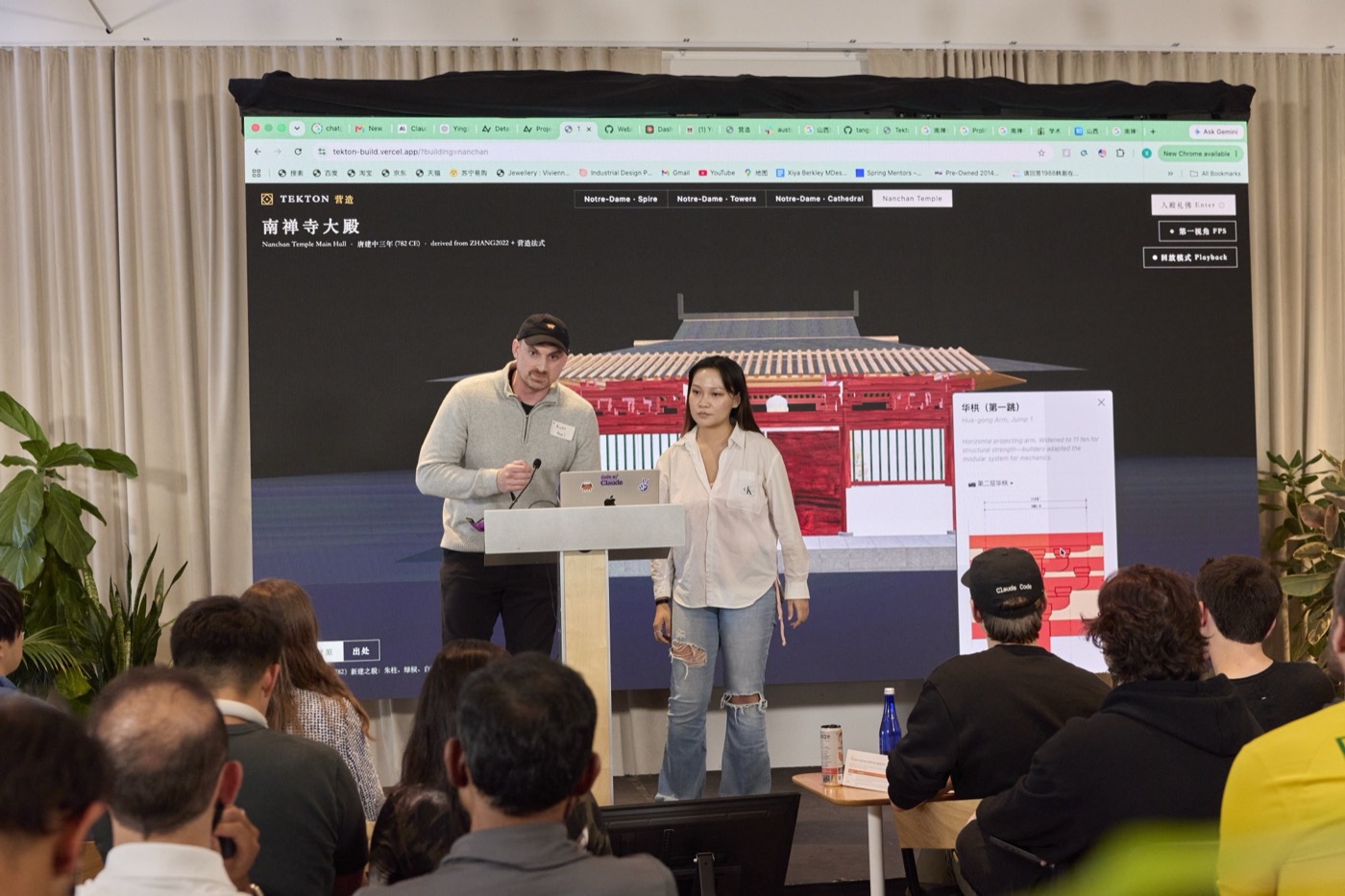
*Holly Tang 和 Austin Burgess 做的 Tekton 是一个 3D 重建平台,能让唐代建筑重新「活」过来,而且每一个构件都能追溯到它的历史出处。*
一座历史悠久的木构建筑一旦被烧毁,几百年的匠艺也可能随之消失。Tekton 用 3D 把这些建筑重新搭起来,并把每一个部件都追溯到有据可查的来源。
给 Tekton 一座历史建筑,Claude 就会去做研究,把图纸、营造文献、照片和图解都汇集到一起,再用 339 个递进的施工状态拼出一个 3D 模型。当你点击模型里的任意一个构件,Tekton 会告诉你这个细节出自哪里、为什么放在这个位置。团队把这个机制叫作「证据链」,它从原始资料一路通向经过验证的模型。他们做这个是为了学术验证、修复工作和文化保护,先从唐代建筑和巴黎圣母院的尖塔入手。
整套验证完全跑在 Opus 4.8 上。独立的验证器子智能体在彼此隔离的上下文窗口里给每一次重建打分,自我纠错的循环则反复检查构件的摆放,直到 20 项测试全部通过。每一次构建都要对照史料及其引证来检验,所以最终模型遵循的,是这座建筑当初被建造时那套有据可查的规则。
Holly Tang 和 Austin Burgess 一个月前才认识,当时两人在一场 Code with Claude 活动上排队买咖啡。Holly 是设计师,一直在帮 Austin 的创业公司 Pearl 做事。「我特别爱看纪录片,每次看到漂亮的建筑毁于火灾,心里都很难受,」Holly 说。她此前自己做过一个单体重建的原型;Austin 的贡献,是把它扩展成能端到端处理任何一座建筑。
为了做出 Tekton,两人分阶段推进:先把巴黎圣母院的尖塔大规模渲染出来,再加上更精细的细节,然后向建筑的其余部分扩展。还没做完整座大教堂,时间就到了。即便如此,还是有好几位黑客松参与者来打听它,或者主动提出帮忙把它做得更准确。Holly 和 Austin 想把 Tekton 开源,这样博物馆、历史学者、非营利组织和政府都能在它的基础上继续做下去。
给其他开发者的建议: 在动手写任何一部分之前,先把整个项目规划清楚。
「我们写了一整份 PRD(产品需求文档),还在 Notion 上建了一个看板,差不多 50 张工单,每张对应一个具体任务,」Austin 说。「那感觉几乎就是,这里是从头到尾的完整项目,每一步我们到底要什么,全都写清楚了。」计划定下来之后,他把整个构建拆成一条条独立的工作流,并行地跑。
第二名:Sim Francisco,Tanmayi Priya Dasari 和 Tejas Prabhune
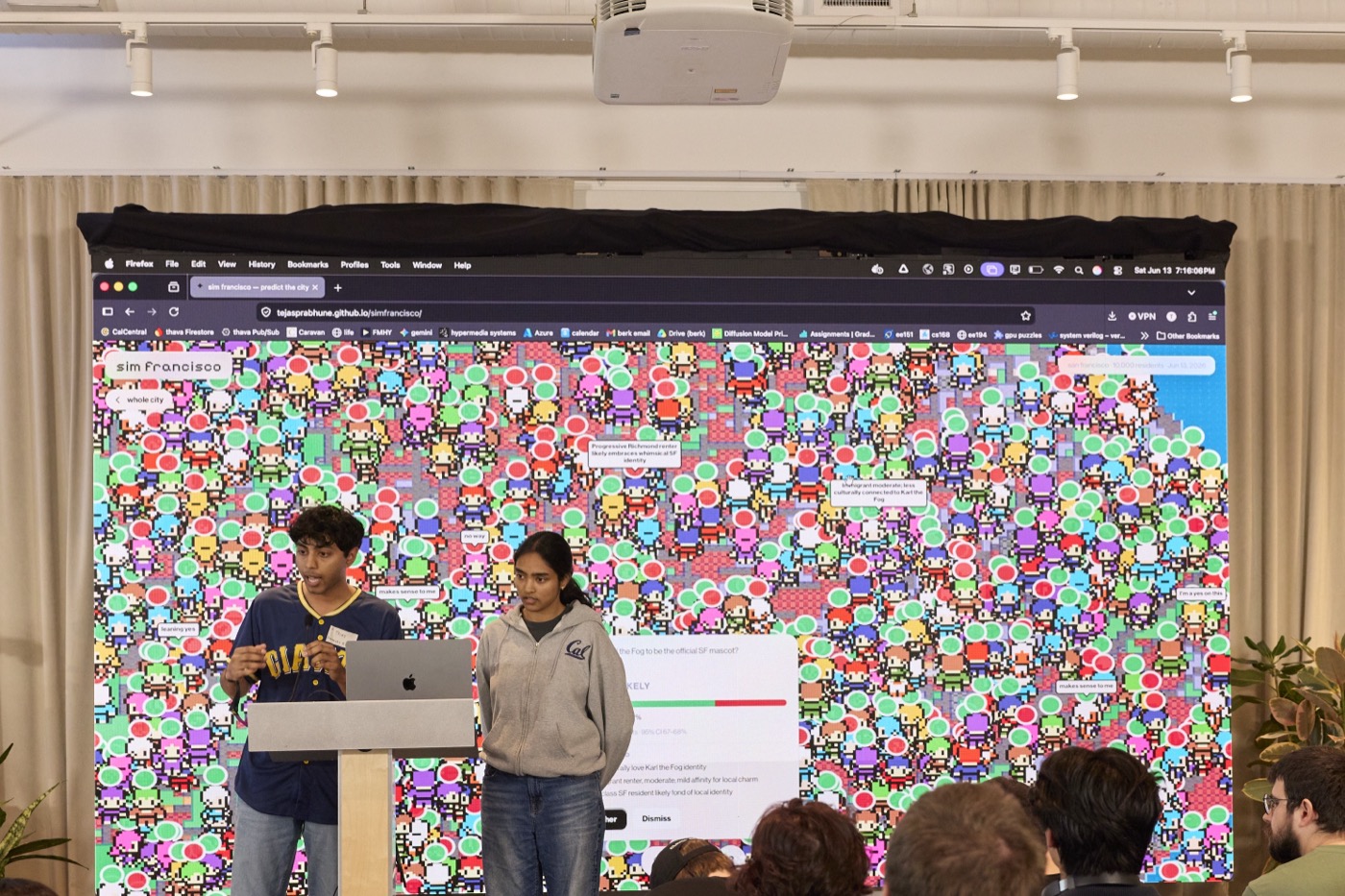
*Tanmayi Priya Dasari 和 Tejas Prabhune 做的 Sim Francisco,是一个以人口普查数据为底料的旧金山人口数字孪生(digital twin),能在几秒钟内给一座合成城市做民意调查,并预测现实世界中的结果。*
Sim Francisco 是一个能运转起来的旧金山人口模型。它有 10000 名取自美国人口普查数据的合成居民,每个人都有自己的人口学特征、个人经历和世界观,散布在城市地图上,实时对新闻做出反应。
向这座城市抛一个问题,它就会逐个街区地给整个合成选民群体做民调。它跑在知识截止日期为 2023 年 10 月的模型上,预测 2024 年总统大选中民主党得票率为 81.3%,实际为 83.8%;预测旧金山 2024 年 3 月的 A 号提案为 70%,实际为 70.38%。它对 Kalshi、Polymarket 这类预测市场的追踪误差在一两个百分点以内。\*
Opus 4.8 写完了整个前端和后端,并端到端地验证了后端的行为。为了验证模型的工作,团队让 Claude 和一个验证器、一个对抗智能体协同作业,搭出一个能复现这座城市真实人口分布的后端。
Tanmayi Priya Dasari 和 Tejas Prabhune 是 UC Berkeley 电气工程与计算机科学专业的学生,两人是在校内的机器学习社团认识的。对 Tejas 来说,Sim Francisco 同时也是在替他正在创办的后训练(post-training)公司做一次验证——他想搞清楚,合成出来的人物画像能不能足够稳定,稳定到可以拿来训练模型完成长周期任务。
给其他开发者的建议: 别满足于第一个能跑通的方案,尤其是当它很烧钱的时候。
团队的第一版是给这 10000 名居民每人单独发一次推理调用,结果成本很高。「慢慢地,Claude 跑了一套它自己设计出来的演化聚类算法,」Tejas 说,把这些居民归并成大约 300 个有代表性的人物画像。归并之后的版本,在 Kalshi、Polymarket 和历史结果上保持了同样的准确率,却把推理成本降到了原来的十分之一到百分之一。
第三名: Custom Universe,Jake Stevens 和 Mauricio Pereira
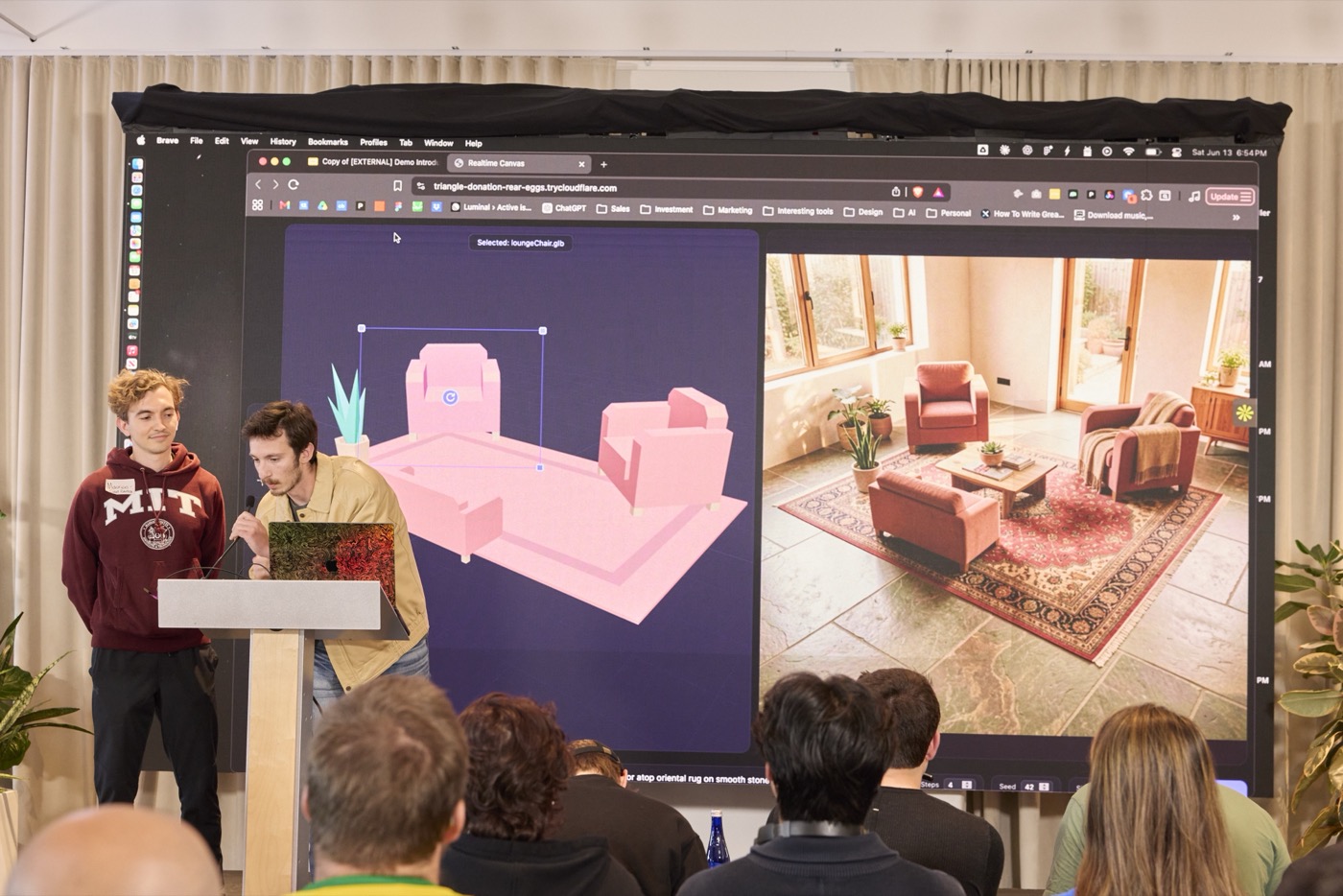
*Jake Stevens 和 Mauricio Pereira 做的 Custom Universe 是一个实时引擎,能把一张手机照片变成一个完全可编辑、照片级真实的 3D 场景。*
用手机拍一张椅子的照片,Custom Universe 就把它变成一个 3D 物体,你可以把它放进一个场景里,用一句文字提示给它换个风格,还能拖着它移动,而渲染出来的画面会实时更新。
这个项目的目标用户是机器人实验室——它们需要大量合成数据,来训练机器人完成特定任务、适应特定环境。一个实验室可以扫描工厂车间里的一台机器,把它放进场景,再生成数据,针对那个具体环境去微调一个机器人模型。要搭起这样一套东西,通常意味着得雇物理学家和工程师来处理物理和碰撞几何。Custom Universe 让你改用拖拽物体的方式来布置场景,团队还打算加上精确摆放,比如把一个物体在厨房台面上挪动 30 厘米。
Opus 4.8 端到端地把这个项目做了出来,还在整场黑客松期间操作着那台远程跑模型的 NVIDIA H100。团队也用 Claude 来判断哪些模型能产出正确的输出,并搭建了那条把手机扫描的物体(用苹果的 RealityKit 采集)导入网页应用的流水线。
Jake Stevens 和 Mauricio Pereira 是在活动上认识的。Jake 是罗切斯特理工学院(RIT)计算机视觉专业的毕业生,经营着一家专注于给 AI 模型提速的创业公司 Luminal;这个场景搭建器,最初是他一直想试试的一个副业项目。Mauricio 是 MIT 机器人专业的毕业生,经营着 Coat Robotics,他带来了自己亲身体会过的难题:机器人领域至今仍缺训练数据,而搭建合成环境又很难。Custom Universe 依托开源模型和算法,可以免费使用;团队说用户可以在自己的 GPU 上跑它。
给其他开发者的建议: 用 Claude 来挑工具,而不只是用它写代码。
「很多次迭代其实是在看哪个模型给出的输出是对的,所以我们用 Claude 做了大量调研,」Mauricio 说。团队还把一些不熟悉的技术直接交给 Claude 去做集成。「比如苹果的 RealityKit,以及我们要怎么保证用户能把扫描好的物体导入我们的网站。我们就问 Claude:把这个加进流水线里。」
*了解**更多关于我们 Claude 社区项目的信息,包括线下聚会、黑客松等等。*
*\*Sim Francisco 是一个独立的黑客松项目,它只是把预测选举结果当作一个示例。这并不代表 Anthropic 认可把「用 AI 模拟来预测选举」作为一种使用场景。*