
AI 的烂账经济学
AI's Brokenomics
If you liked this piece, you should subscribe to my premium newsletter. It’s $70 a year, or $7 a month, and in return you get a weekly newsletter that’s usually anywhere from 5,000 to 18,000 words, including vast, detailed analyses of NVIDIA, Anthropic and OpenAI’s finances, and the AI bubble writ large (updated to version 3.0 last week). My Hater's Guides To the SaaSpocalypse, Private Credit and Private Equity are essential to understanding our current financial system, and my guide to how OpenAI Kills Oracle pairs nicely with my Hater's Guide To Oracle.
Last Friday, I published the first of a two-part series where I explore the many bubbles that form the basis of the AI bubble — including the tokenomics bubble, and the cult of personality bubbles surrounding Sam Altman and Dario Amodei.
Subscribing to premium is both great value and makes it possible to write these large, deeply-researched free pieces every week.
Soundtrack — Local H — Manifest Destiny (Part 2)
We live in a time of deep uncertainty. On Friday, Anthropic was forced to shut off access to its Mythos and Fable models after the US government imposed an export control ban barring any non-US citizens both inside and outside of the country from accessing them.
To explain, Fable is basically Anthropic’s supposedly “too dangerous to release” Mythos model with guardrails forbidding you from what appears to be anything biological weapons and cybersecurity, except it was jailbroken within days by Amazon researchers, leading to Amazon CEO Andy Jassy (and other unnamed companies) reporting it to the US commerce department which gave Anthropic 90 minutes to roll back Fable and Mythos due to “national security risks.” Semafor also reports that this all might have happened because China got access to Mythos.
This situation is a complete mess. PCast co-chair and podcaster David Sacks claimed that Anthropic refused to fix the issue, claiming it wasn’t serious, per Business Insider:
During the calls, Amodei tried to clear up what he assumed was a misunderstanding. He pushed back on the administration's concerns, defended the guardrails, and argued that the type of bypass that occurred, which he believed to be specific, did not pose the same risk as a broader "jailbreak" that would allow it to be used without any of the guardrails put in place by Anthropic.
In a blog post after the export controls were put in place, Anthropic said that "no testers have yet been able to find a universal jailbreak — a jailbreak method that can very broadly bypass the model's safeguards, unblocking a wide range of cyber capabilities," and that total avoidance of any jailbreaks isn't now possible for them or any other companies. They defended their systems, which they said "are so strong that many users have complained that they are overly broad."
A White House official told Business Insider that “export controls were a last resort after begging them for hours to work with us”:
Shortly after the call, the Trump administration imposed its export control on the Fable 5 and Mythos 5 models, citing national security authority and banning their use by foreign nationals, according to Anthropic. The company said the "net effect" of the order was to "abruptly disable" the models for all customers "to ensure compliance."
Anthropic claims no begging occurred, and all it got was (as noted above) 90 minutes. According to Axios, the company has dispatched some of its senior technical staff to D.C to negotiate with the Trump Administration, after virtual meetings with White House officials failed to bear fruit.
In any case, this is a reaping/sowing for the ages. Dario Amodei has spent years selling AI models based on completely fantastical scaremongering about the “rapid advancements” of large language models, cresting the hill in April when he announced Claude Mythos, an LLM that was “too powerful to release” until June 2, when it was released to 150 organizations in 15 countries, and June 9, when it was released with said guardrails under the name “Fable.”
Fable is, of course, just another large language model that’s an indeterminate amount of “better” than the last one. Having talked to multiple people that claim to have used Mythos and deeply enjoyed Davi Ottenheimer’s takedown of its system card, it appears to be much the same model but with security protocols flimsy enough to last only a few days before anonymous researcher Pliny The Liberator broke them. Anthropic has not created recursive self-improvement, nor has it done much more than create a very large language model that gets higher benchmarks in tests built for large language models, wrapped in a veneer of mysticism and panic-hype built to scare organizations in paying them to use it.
The problem with this kind of hype is that you can only use it for so long before somebody believes you. The outright mythology of Mythos existed to scare people and help Anthropic raise at a $965 billion valuation, and because the tech industry has existed fairly divorced from reality, scrutiny, and regulation, Dario Amodei continued to inflate the “Anthropic is too powerful” bubble, believing that all that would happen would that he’d create a new enterprise API business.
Some are attempting to read this story as bullish for Anthropic — that the government will work with it to bring the models back online, creating a proxy marketing campaign for its models — and while I think that’s possible, if not likely, I think there’re many other possibilities.
On Sunday, slopagandist and Microsoft CEO Satya Nadella posted a mealy-mouthed blog on Twitter that didn’t really say very much of anything, but had two interesting comments:
The last thing any of us want is a world where every company across every sector is ceding value to a few models that eat everything they see. If all the value is accrued by only a few models, the political economy will simply not tolerate it. There is no societal permission for an AI future that hollows out entire industries.
…
In my view, our priority has to be building a frontier ecosystem, not just a frontier model, so value flows broadly across every company, every industry, and every country. One where every organization can own the learning loop that encodes its institutional knowledge, compounding its human and token capital.
This, combined with Microsoft AI CEO Mustafa Suleyman saying Anthropic’s models were too expensive and Andy Jassy likely being part of the reason that Anthropic got banned makes me think that hyperscalers might be trying to cast doubt on the inevitability of AI labs. While Nadella’s piece has clearly gone through 8 PR people and 16 lawyers, it seems to smell of a company saying that no one model actually matters, and given that it was posted on a Sunday, I’m going to guess it’s about the current Anthropic situation.
It’s hard to see how everything goes back to normal from here. Even if Anthropic gets its models greenlit for availability, it’s clear the government has some animus against it after Q1’s battle with the Department of Defense, and may or may not have been waiting for an opportunity to rattle Dario Amodei’s cage.
And, according to Axios, there’s a real animus between the US government and Anthropic, caused in part because of its “inability to communicate effectively,” with one source saying that “Anthropic has not done a great job at trying to speak to the administration and appreciate the ideological differences."
Alternatively, the government has taken Anthropic’s (nonsensical) marketing seriously, and thus decided to take the kind of blunt-force authoritarian position you’d expect — shut the whole thing down, as China might use Mythos to uh, do something!
The other problem is that this is terrible, terrible timing for an AI industry in the throes of a cost crisis. Anthropic and OpenAI’s IPOs depend on myth, hype, and certainty that their growth will never slow. The government’s ability to cut off access at random based on genuine concerns or politicking isn’t a great advertisement at a time when everybody is struggling to find the ROI of AI.
This isn’t a Too Big To Fail or nationalization situation. Amazon and Microsoft are far more scared of the White House than they are of killing their golden goose, and may honestly be relieved to find a reason to bring this era to an end.
You see, Anthropic and OpenAI have much bigger problems than regulation or pissing off Pete Hegseth.
Their business models don’t fucking work.
Can We Wrap This Up Already?
I’ve been saying for years that the underlying economics of AI don’t make sense — that AI labs were intentionally obfuscating the costs of subscriptions and heavily subsidizing users’ compute, and that the moment that that changed, everything would begin to fall apart, and god damn has it finally begun.
As I discussed in last week’s premium newsletter, the AI Tokenomics Bubble is the simplest and most consequential of them all, because it comes back to something I’ve been saying for years: that the majority of users will refuse to pay the actual cost of AI.
Said bubble inflated through the combined failure of the tech and business media to question AI’s economics and the unprecedented subsidy con perpetuated by Anthropic and OpenAI. Those who dared to suggest that OpenAI burning $5 billion was some sort of problem were dismissed as haters and skeptics that “didn’t care about the future,” with the vast majority of the media completely ignoring the economics until the latter half of 2025.
The Tokenomics Bubble inflated because everybody aggressively ignored the AI industry’s greatest weakness, choosing instead to repeat tired mythologies about how Uber lost a lot of money (which I’ve refuted here) or Amazon Web Services cost a lot of money (Amazon’s total capex between 2003 and 2017 was $52 billion normalized for inflation) instead of being skeptical of…well, anything.
And now it’s bursting because Anthropic and OpenAI’s customers are in revolt, to the point that they’re planning “drastic” price cuts.
How The Tokenomics Bubble Burst
Alright, let’s do this one last time.
Sometime early in Q1 2026, Anthropic and OpenAI moved all of their enterprise customers to token-based billing, meaning that instead of using subsidized subscriptions with varying (and ridiculous, as I’ll get into) rate limits, big businesses suddenly had to pay for their AI usage based on the actual tokens they used.
Many hailed this as a masterful gambit, assuming that organizations would have near-infinite budgets for AI services that had yet to prove themselves useful.
It only took a few months for OpenAI and Anthropic’s customers to start sweating.
In the middle of April, The Information’s Laura Bratton likely burst the AI bubble with a piece about how Uber had burned through its entire annual token budget in a single quarter.
This kicked off an industry-wide anxiety about the mounting costs of AI, with multiple other companies burning millions of dollars in the space of a few months, including Zillow, which destroyed its annual Cursor budget by the end of May. What really began the downfall was a comment by Uber COO Andrew Macdonald:
"That link is not there yet, right?" he said. "I think maybe implicitly there is more that is getting shipped, but it's very hard to draw a line between one of those stats and, 'Okay, now we're actually producing 25% more useful consumer features."
He said that the trade-off costs from AI are harder to justify because he can't draw a direct link. Earlier this month, CEO Dara Khosrowshahi said in an earnings call that Uber was slowing hiring to counter its investments in AI.
In a single podcast, Andrew Macdonald gave the entire tech industry permission to say the truth: that nobody was actually able to show any ROI despite its massive costs.
This was always going to be a problem. By starting everybody off with subsidized subscriptions, AI labs shielded users from the costs, training them by proxy to use AI models without any concern for efficiency.
That, and organizations are run by Business Idiots beguiled by a captured tech and business media and a complete disconnection from actual work, meaning that they’d encouraged (or forced) their workers to use AI as much as humanly possible, never once thinking about the costs until they were made to by the AI labs. All it took was a few months of tokenmaxxing to start turning organizations’ stomachs.
This began an increasingly-anxious conversation around AI’s ROI, made worse by the fact that you can’t measure the cost of a task because of the sheer number of models and harnesses, and can’t cleanly translate “AI spend” into “actual financial outcomes.” Toward the end of May, Axios would publish a story about how a company somehow spent $500 million on Anthropic tokens in a single month after failing to set up cost controls.
A few days later, Sam Altman would make a massive fuckup, saying that customers were “totally happy” with their AI spend at the beginning of the year (before token-based billing), and that spend was now a “huge issue,” likely because the costs vastly increased.
Boosters would immediately argue that these massive costs were, in fact, proof that AI was very successful, even if said “success” came from organizations that let their workers burn as many tokens as humanly possible without any consideration of the cost. As I’ve argued previously, the vast majority of Anthropic’s recent surge in revenue comes from experimental revenue from paypigs that it doesn’t deign worthy of clear visibility into their organizational token spend.
In any case, OpenAI and Anthropic need to make a combined $358 billion in annual revenue by 2029 to keep up with their $1.1 trillion in compute commitments. Any slowdown in their growth, as I discussed last week, would be fatal to two companies that have marketed themselves almost entirely by putting the cart before the horse.
Less Than 3 Months Into Token-Based Billing, Both OpenAI And Anthropic Are Considering Price Cuts
It turns out that Altman wasn’t kidding that costs were a “huge issue” for his customers.
Around a week later, The Wall Street Journal reported that OpenAI was planning “drastic” price cuts to its token prices in response to Anthropic potentially doing the same:
OpenAI is considering drastically lowering the prices it charges users as it seeks to win customers from its rival Anthropic.
The company is weighing significant cuts to what it charges for tokens, the unit of measurement artificial-intelligence firms use to bill for their products, according to people familiar with the matter. The move would be in anticipation of similar cuts the company expects at Anthropic, the people said.
Business executives have begun to balk at the high prices for AI usage. OpenAI Chief Executive Sam Altman said at a recent event that costs had become “a huge issue.”
If you’re wondering why they might be doing so, earlier in the day, Cisco President and Chief Product Officer Jeetu Patel said exactly what everybody had been thinking but were too scared to admit: that “...the costs of [AI tokens] are far higher than the actual value that these tokens are generating at scale.
I cannot express how deadly these price cuts would be to the AI industry, and how dangerous this conversation has become. The move to token-based billing has created a revolt in the AI industry’s customer base, coming from (as I’ve discussed) a confusion around the actual ROI and utter despair around the costs.
Depending on how “drastic” these discounts are, any (entirely theoretical) gross margin these companies make on inference will be eaten alive…all so that OpenAI and Anthropic can…uh…decrease their revenues? It’s a desperate strategy being deployed, I imagine, because of a massive wall of customer churn as a result of Business Idiots spunking millions of dollars on tokens they’re no longer able to justify.
Remember: we’re less than three months in to organizations paying the actual costs of LLM-based services, and they’re clearly so outraged at the spiralling costs that both Anthropic and OpenAI are planning to cut the prices of an already-unprofitable service, likely collapsing their revenues while increasing their overall costs.
I anticipate a few booster quips in response, so let’s address them head-on:
- This will make organizations spend more on AI!
- The problem with this idea is that it assumes that organizations are currently burning the amount of tokens they intend to burn forever, when in reality, most organizations have no idea how many tokens they want to burn, just that they’re spending way too much burning them!
- This means that there’s every chance this both cuts revenues and ends up with organizations using fewer tokens. Remember, nobody can actually measure the ROI of AI! A 50% price cut doesn’t actually answer the question of “why am I paying so much for this,” and unless the price cuts are to DeepSeek levels (which would also be fatal), it’s hard to see how organizations are going to be won over.
- They’ll drop the prices then raise them again in the future!
- Oh you sweet summer child, you really are attached to these companies, aren’t you? What do you think customers will do when the prices go up again? Do you think they’ll say “thank you so much sir for raising the prices”? Or do you think they’ll say “hey man I didn’t like these before and I don’t like them now”?
- They’ll have a haves-and-have-nots system where only some models are discounted but the expensive ones are the only good ones!
- …that…that’s what’s happening right now? Even if Anthropic decides it only sells Mythos or Fable or whatever to big enterprises, these are the same big enterprises that are complaining about the price!
- Jevon’s Paradox Jevon’s Paradox Jevon’s-
- Shut the fuck up!
I Will Fucking Piledrive You If You Mention Jevon’s Paradox Again
Here’s what Jevon’s Paradox means, per Planet Money:
It was within this context that economists rediscovered the Jevons paradox. And they created a modern formulation that's a bit more nuanced. The idea is that making things like cars and appliances more energy efficient creates a "rebound effect." When you make a machine more energy efficient, it effectively lowers the cost of using it. And — hello, the classic law of demand from economics — when stuff gets cheaper, people tend to use or consume more of it.
So, for example, with more-fuel-efficient cars, it gets cheaper to travel every mile, so people drive more miles. Some may decide to stop riding the bus and buy a car. Some families may buy a second car. Others may buy bigger vehicles, like SUVs. With more-efficient light bulbs, people may keep their lights on for longer or build things like the Sphere in Las Vegas.
Newsflash! These price cuts are not happening because Anthropic or OpenAI made their products more efficient! They’re making these price cuts because their customers don’t want to pay their current prices!
In fact, their costs appear to be increasing, which is why they’ve raised (assuming the rounds completely close) over $230 billion in the last six months. You don’t do that unless you think your costs are about to explode or, I dunno, you’re about to massively increase your losses, though the timing and velocity of these price cuts suggests this was a very recent idea.
Oh, right, Jevon’s Paradox! This isn’t that. These companies aren’t getting more efficient. They don’t have any bright ideas to make their businesses lose money, and in fact seem pretty incompetent when it comes to growing their revenues outside of scamming dimwits and selling people $40 for $1.
And that is not hyperbole.
Generative AI Does Not Have A Business Model
So, you know how I keep going on about “subsidized subscriptions”? And how people online keep saying that they’re not really subsidized?
Well, SemiAnalysis, an extremely pro-AI semiconductor analyst, ran a test made up of random long-horizon coding tasks until they maxed out the limit on OpenAI and Anthropic’s various subscription levels.
Their findings were shocking.
For $200 A Month, You Can Burn $8000 in Anthropic Tokens or $14,000 In OpenAI Tokens
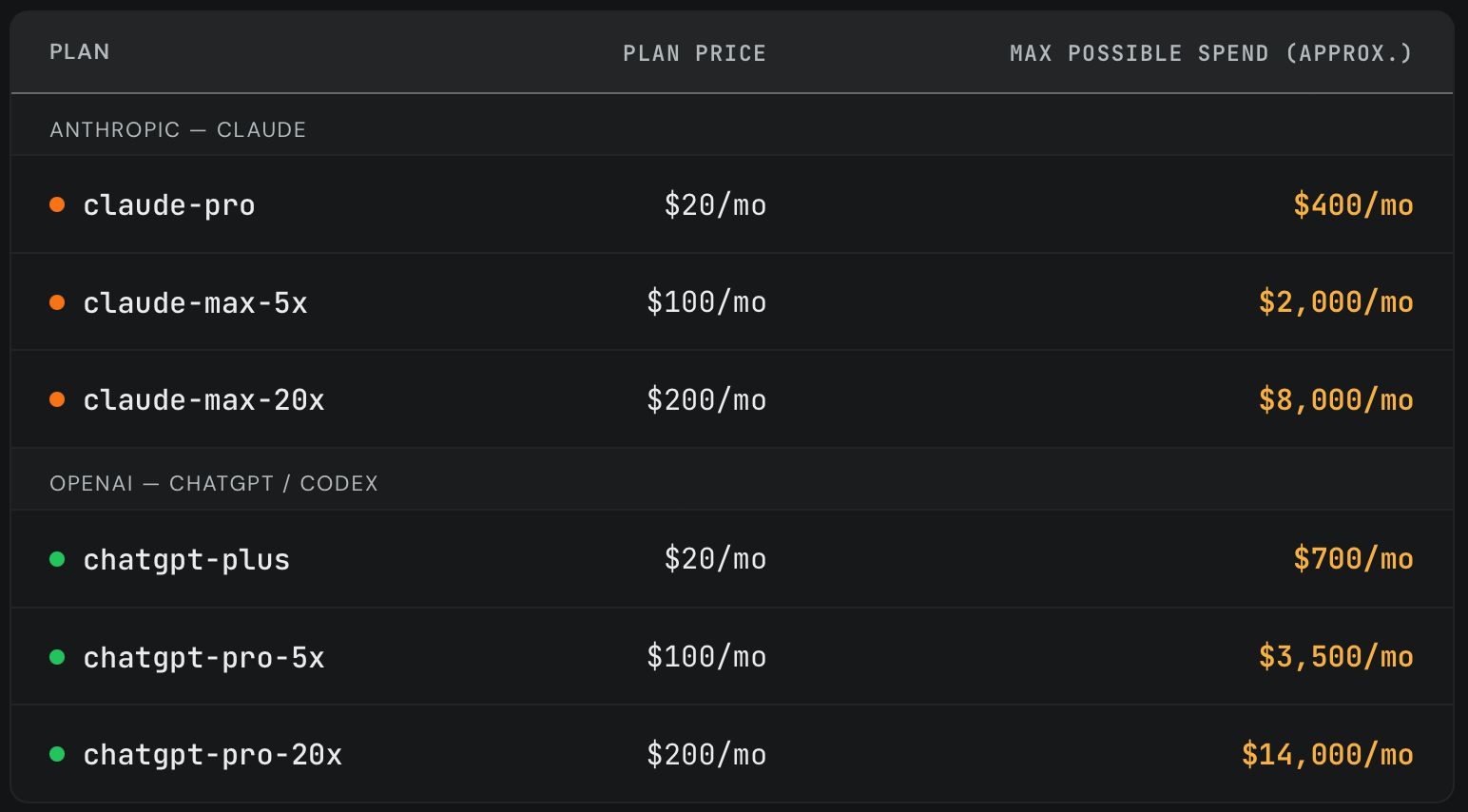
That’s right. Anyone with a $200-a-month Anthropic subscription can burn $8000 in tokens, and with a $200-a-month ChatGPT subscription, you can burn $14,000 in tokens.
This business fucking stinks! It’s not even a real business! OpenAI and Anthropic have to give away somewhere between 20 and 70 times the cost of their subscription in API tokens, which means that they realize that the vast majority of people value these tokens at a fraction of their real cost. This obscene and wasteful subsidy is what you do when you have little to no confidence in the actual value of your product!
Sidenote booster quip: But Ed It’s The Gym Model! Newsflash, chuckles! If you’ve got 2000 people who pay $20 a month but barely cost anything it only takes three people spending $14,000 to eat every single dollar of that revenue! And trust me, I’m about to get to the margins.
SemiAnalysis also modeled out — based on the ridiculous assumption that OpenAI and Anthropic have a 75% gross margin on their tokens — what the margin of a user looks like, and I’m sure it’s f-OH MY GOD!
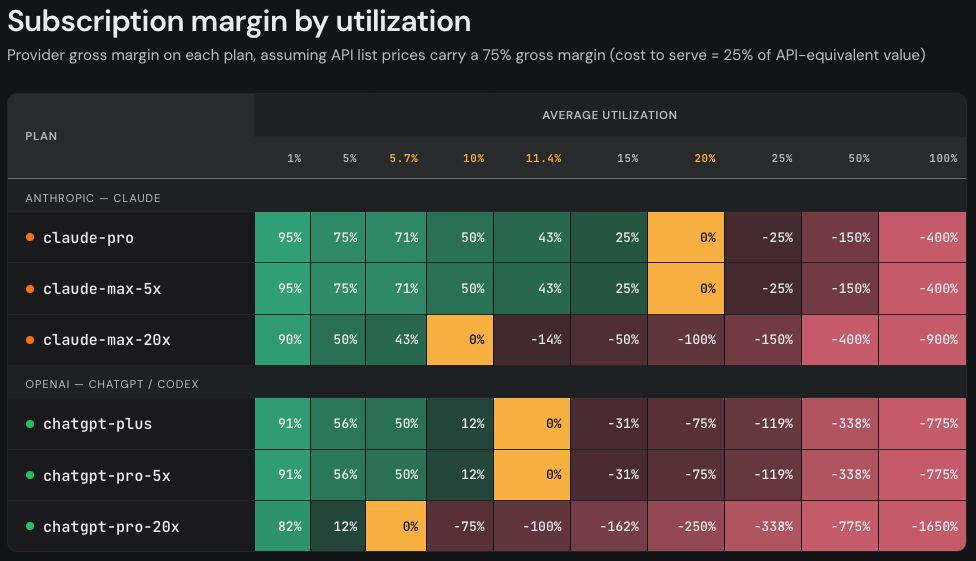
That’s right folks. With the current subsidies, all it takes for a user to have a gross margin of at best negative 25% is for them to use as little as 25% of their rate limit. And this is based on the generous assumption that they have a 75% gross margin on tokens!
I’ll repeat myself: this is not a real business! This is a joke business, a comedy business, a business invented by the Gods as a means of mocking venture capital! For Sam Altman and Dario Amodei to run a business in this fashion is a sign that they have utter contempt for their investors, the tech media, sell-side analysts, and the general public. If you or I ran our lives in this way, we’d be called fiscally irresponsible millennials that believe the world owes us everything.
This isn’t a real business model because generative AI companies are not real businesses.
Generative AI does not have a business model. It is not a tool with value remotely commensurate with its costs. It isn’t getting cheaper for the providers or the customers. It isn’t becoming “better” in a way that’s measurable using anything other than benchmarks invented specifically for generative AI — an industry-wide coddling of a mediocre technology that only makes money through massive subsidies, FOMO and executive ignorance. It requires endless pre-training, post-training and script-based MacGuffins to do tasks with mathematically-guaranteed hallucinations that burn more tokens, raising costs on customers who are already in mutiny less than a quarter into being forced to pay a cost that is already unprofitable.
Boosters and the recently-concussed will say that these companies can simply stop training, to which I say if that was possible they’d have already done it, and if they stop training, the models will eventually drift into obscurity. If stopping training was all that it’d take to turn these businesses profitable, they’d have done it already, because inference would be a money-printer rather than a cursed object eating away at Altman and Amodei’s souls.
The AI Cargo Cult Is Collapsing
I’ve said it once and I’ll say it again: I believe a large majority of AI token spend — and specifically Anthropic’s revenue growth — has come from Business Idiots disconnected from any real work that have become convinced that “lots of AI” would do something other than rack up massive bills.
And wouldn’t you know I was right!
A little over a month after encouraging its workers to “tokenmaxx,” Meta is now planning to pull back on its AI token spend after realizing it was on track to spend billions on tokens, per The Information:
Meta Platforms plans to clamp down on skyrocketing AI costs inside the company by imposing limits on employees’ token usage, the company told staff in a memo on Tuesday, just weeks after it pushed them to adopt AI tools in their work.
The company is building an internal platform to track employee AI usage and spending in real time, set budgets and establish limits on employees’ token spend, according to an internal memo reviewed by The Information, which Meta shared with about 6,000 staffers earlier this week. The effort is part of a broader efficiency program aimed at cutting costs.
“We’ve seen an exponential increase in AI usage and [we] are tracking to spend billions on internal use alone in 2026,” the memo said. “At the same time, individuals and teams have limited visibility into and control over how they use AI. In 2027, we expect Meta will move toward managing AI tokens in a more structured way—with budgets, allocation decisions, and supporting tools.”
It didn’t even take two months for Meta to go from encouraging its employees to compete to burn the most tokens to talking like a British MP giving a speech about austerity measures.
Meanwhile, The Times reports that banks are running up massive nine-to-ten figure bills from “experiments with artificial intelligence tools”:
Ben Faes, chief executive of RWS, said that businesses were becoming increasingly conscious of the costs involved, without a clear outcome on how it should be used.
“It is very exciting, but you know the cost of playing around with all this AI is rising quite dramatically,” he said.
Faes, 54, said he had spoken to two large banks which between them had racked up $1 billion in costs from experimenting with AI without generating a significant return on investment.
“It is a serious point,” he said. “AI isn’t about generating pictures of cats on skateboards. It’s becoming a serious cost centre for businesses.”
These are the kinds of things you say when you’re planning to drastically cut costs, and I think Uber’s COO gave everybody permission to admit the lack of ROI or, well, any measurable benefits of spending millions of dollars on AI tokens.
Remember: Business Idiots are lemmings! The only reason they wanted to “do AI” was because they read it in the newspaper or heard somebody they thought was intelligent insist that it was the future. These people are extremely sensitive to suggestion (see: Nik Suresh’s Brainwash an Executive Today) and marketing hype, which means they’re also extremely sensitive to peer judgment, meaning that if the worm turns and everybody starts saying “I’m not sure we should spend as much money on AI,” they’ll become anxious to be judged as wasteful for doing something that was considered innovative mere months ago.
Some are suggesting that lower-priced open source models (including some developed in China) for some operations could be the solution, per the Wall Street Journal:
The ecosystem allows autonomous AI systems, or agents, to use cheap models—including those made by Chinese companies like Alibaba and DeepSeek—for many functions. The agents only tap the most capable versions of OpenAI’s ChatGPT and Anthropic’s Claude for more complex tasks. That can reduce costs for some AI-assisted work by as much as 95%, according to executives using the tools.
“Once we find something that is working well and engineers love, we find ways to make it cost effective,” said Dan Robinson, founder of Detail, a startup that identifies bugs. “There’s really an embarrassment of riches right now coming out of the open source labs.”
Robinson shifted 90% of Detail’s workload from Claude and Google’s Gemini to custom models and GLM, a family of models developed in China.
The problem with this argument is that we’re yet to prove if running these models is profitable (or even sustainable) for any provider, nor do we have tangible proof that they can compete at scale with Anthropic or OpenAI’s more-complex LLMs.
Citadel Securities argued late last week that they might be:
For the economy at large, simpler models may be the more cost-effective, productivity-augmenting pathway until physical constraints are eased. We hence see growing signs of a bifurcation in frontier vs “everyday” AI usage.
The problem is that the hundreds of billions of dollars of AI data centers full of NVIDIA GPUs are being built with the expectation that there will be incredible demand — over $150 billion a year just to cover what’s under construction — for very large and compute-intensive models. I am still skeptical that this is a real shift away, if only because using open source models requires you to either work with an inference provider or run your own GPUs.
Nevertheless, even the hint of this migration is enough to start making Business Idiots say “hmmm, what about open source?” even if they don’t know what that means.
But everything comes back to one very simple point: that a lot of AI use (and by extension AI spend) is from the cargo cult mentality of an economy run by the most easily-led dullards in history. They jumped on the AI train because they saw a webinar or read a LinkedIn post or saw a news story about Sam Altman saying his tech was scary or an Atlantic piece saying that Claude Code was ChatGPT 2.0 and thought “fuck, I better throw as much money at this as possible.”
In the end, what is it these organizations are paying for? They’re not replacing anyone, and there isn’t compelling evidence that AI models speed people up. Allowing non-technical people to use LLMs to write code isn’t speeding up the delivery of software in a measurable way, and introduces obvious problems in the sense that, well, you’ve got a bunch of code written by somebody who can’t read or understand it.
People will argue that AI is “really helpful with research,” despite the fact that any research you receive from AI will absolutely have hallucinations, meaning that if you don’t actually know what the answer is to a particular question (which, I assume, is why you researched it), you’re certain to have some sort of small (or large) fuckup.
In a story that’s a little on the nose, The Financial Times reported last week (covering a study by GPTZero) that a KPMG report (that’s now been taken down) about the benefits of AI had exaggerated the scale of its adoption through multiple AI hallucinations:
The October report, “Redefining excellence in the age of agentic AI”, made numerous false claims about the use of AI by organisations including the Swiss bank UBS, the UK’s National Health Service and the public transit groups Swiss Federal Railways and Transport for London.
The inaccuracies were identified as AI hallucinations by the research group GPTZero and verified by the FT. After being alerted to the issue, UBS said it would ask KPMG to remove the false claims, and the Big Four firm on Thursday pulled the report from some of its websites.
The KPMG report claimed global wealth manager UBS “integrates AI agents across investment advisory, risk management and compliance monitoring”. A spokesperson for [UBS] told the FT the assertions were “factually incorrect”.
The report also included hallucinations about AI agent use by Swiss Federal Railways, Transport for London and NHS Greater Manchester, fabricating entire integrations and product lines in a report that was likely used to justify billions of dollars of spend.
Per GPTZero, 40 out of 45 of the report’s citations are either fake, make critical mistakes about the contents, or lack enough detail to be used as proof. They also believe that whoever wrote the report let the AI do most of the work:
Our team suspects that the authors of Total Experience used an AI-powered referencing tool to generate the report’s citations because the errors are both mistakes typical of Large Language Models (LLMs) and consistent throughout the reference list. A human would not consistently paraphrase titles, mistake topics for authors (e.g., citation 9), or repeat information across multiple components (e.g., citation 2).
GPTZero also notes that the report is being cited by LLMs as evidence to prove the success of AI agents, poisoning the already-hallucinatory well of information that these models draw upon.
KPMG has annual revenues of over $39 billion, and sells something called KPMG Workbench which promises to “supercharge your business with [its] multi-agent AI platform, combining advanced, trusted AI agents with insights and deep industry expertise of KPMG professionals.” I assume these are the same professionals that greenlit the report.
It’s likely that this was a mixture of laziness and ignorance, but I also think it might be a situation where the person (or people) writing the report simply couldn’t find any real citations to prove their point, choosing instead to let an LLM crap out some thought-slop in the hopes that nobody would notice.
The fact that Anthropic and OpenAI have any business left after stories like these is proof that the vast majority of companies paying for these services are doing so because they feel pressured to by their peers, investors or the media.
That’s not a tenable business model! You can only get so far on FOMO, gaslighting, and the vague promise that something good will happen if you hand over your credit card.
Hell, let’s take it one step further: neither OpenAI nor Anthropic is a real business.
OpenAI and Anthropic Are Not Real Businesses, And Can Only Make Money By Giving It Away
Let’s cut to the chase: these aren’t real companies!
Their businesses only function by subsidizing or swindling their customer base using deceptive media campaigns that say “let people use as much AI as possible,” and it’s becoming clear that token-based billing might genuinely not work as a viable business line.
The only hope that these companies had was the possibility that they could actually charge something approximating their real costs, though I’d argue that was only the case if there was the option for OpenAI or Anthropic to increase their token costs in the future.
To make matters worse, it’s abundantly clear that the vast majority of people would never actually pay for the tokens they burn. If OpenAI and Anthropic are allowing their customers to burn such egregious amounts of tokens, it’s because they’ve seen that their customers churn when they don’t get to do so. Anthropic’s aggressive rate limiting in March — which still allowed people to burn far more than their subscription cost! — likely scared the everliving shit out of them, to the point that they signed up to pay Elon Musk $1.25 billion a month for access to his Colossus data centers specifically so that they could give people higher usage limits.
The only way that these companies can make money is by giving it away. Both OpenAI and Anthropic have recently started handing out $1000 in API credits to convince people to move over to Codex or Claude Code.
Sidenote: Now OpenAI is allowing its users to “bank” their rate limits — meaning that instead of waiting for the weekly (or hourly) reset, you can choose to save them up and, I assume, use them back to back, allowing power users to effectively double-tap OpenAI’s servers once they’ve run through their usage.
Also, for the next two weeks, anyone they refer gets a free trial of Codex and both of them get another banked reset. This is a transparent attempt to juice user numbers at a cost of hundreds (or thousands) of dollars, and will almost exclusively be used by power users gaming the system.
Their services are not valuable enough for people to cover their business expenses, even if you remove the cost of training, which is so severe it drowns out every dollar of revenue on its own. They cannot raise prices — or even bring them in line with their costs — without their users flipping out. Their training costs are necessary to continue making their models an indeterminate level of “better,” which means that they’re a cost of goods sold, and not a capital expenditure.
As an aside: I’ve been told by somebody that Anthropic has been telling people that they can consider token spend a capital expenditure. I am warning any company in the entire world that if I find out you did this, I will haunt you for the rest of time. I will watch everything you do forever, as this is bullshit accounting that verges on fraudulent, and I can imagine some asshole is going to do it.
Anthropic and OpenAI want you to believe that their businesses can somehow turn profitable, yet neither of them have any explanation as to how. Anthropic negotiated discounted compute for the first two months of its SpaceX deal as a means of pretending to be profitable for a single quarter, but any price cut — or even customer churn! — will immediately put its finances in a kind of red usually reserved for the deeply embarrassed or steroid-enhanced.
They do not have a plan.
You can go on about TPUs, Trainium, Inferentia, and custom silicon for as long as you like — it’s not profitable to run these companies, their costs are too high, and their customers are price-sensitive. Their customers lasted less than three months paying for their actual token burn before crying for mercy. There is no reversing this trend, because if there were, OpenAI and Anthropic would’ve reversed it in any way, shape or form, rather than raising more money than anyone has ever raised before for what appears to be no reason other than to burn it.
OpenAI and Anthropic are unsustainable and recklessly-run companies that do not make sense outside of the broken world of Silicon Valley. The tech industry and venture capital are run by a coterie of has-beens who create no value, and the vague memories of the pre-2015 era, before investors gave up on investing on seed stage companies and decided to joylessly trend-hop for years until they were driven insane by COVID lockdowns and “X: The Everything App.”
The tech industry is run by people who do not experience real problems or have to run real businesses, because a cluster of fellow grifters will vault them back into the black. Investments are no longer made based on rugged meritocracy or any interest in creating the future — it’s only about the Rot Economy’s mediocre growth-at-all-costs accelerationism and making varying numbers go up, though very rarely ones associated with profits.
I think it’s fair at this point to ask whether you could’ve just hired real people to do the shit that AI has done given its enormous cost. $14,000 could probably get you a great deal out of a real software engineer — hell, you could’ve probably hired an agency to do the work for you and actually have someone manage the risk.
The completely imaginary assumption about the AI industry is that it’ll magically get cheaper. That is not something that’s happening. More data centers will not make OpenAI or Anthropic profitable. More data centers will not make customers more willing to pay the actual cost of AI. More venture capital funding will not make Anthropic or OpenAI real businesses.
I agree with anyone saying there should be a pause in the development of generative AI, but I do so based on the belief that this is a doomed grift and science experiment masquerading as an industry that has only gone on this long because it allowed the hardware industry to extract hundreds of billions of dollars from startups, venture capitalists, asset managers, and retirement and insurance funds.
And anyone in Silicon Valley fooling themselves into believing they’re anything other than a corporate stooge is a mark.
Silicon Valley Is A Monoculture
The AI industry is the direct opposite of what made Silicon Valley famous.
It is a flattening of everything, absorbing the majority of venture capital funding, media attention, talent, and intellectual oxygen, invading whatever space you’re in because investors insist you must have something to do with AI and because everybody has been convinced they have to use it. It is an intellectual black hole, dragging every conversation toward it, demanding the most money, the most focus, endless justifications and defenses from people that must be rejected for questioning whether LLMs are the future. It debases and humiliates its fans by forcing them to constantly face indignities and embarrassments like it deleting entire databases or breaking AWS. It stunts the intellects of those who use it and, in demanding complete devotion to be considered “part of Silicon Valley,” suffocates the kind of meritocratic skepticism that allegedly got these fuckers so rich.
Silicon Valley was founded on the potentially fictional idea of plucky software developers that rejected the bounds of corporatism. It’s now ingested the worst qualities of corporate America — groupthink, trend-hopping, tribalism, hero-worship, managerial feudalism, and wasteful spending chasing things based on what might make a rich, heavily-coddled oaf smile. There is nothing daring or individualistic about Silicon Valley. At this point, you may as well work at fucking McKinsey.
Silicon Valley is the establishment. OpenAI and Anthropic are effectively owned by Microsoft, Google and Amazon — they do not have infrastructural or financial dependence, they principally run on their hardware, and if anything happens to them, they will likely be absorbed into multiple arms of the Magnificent Seven.
Their financial success benefits only the richest people in Silicon Valley and the wealthiest companies on the stock market. They sell themselves as democratizing software as they extract as many dollars as possible from venture capital, all while selling them back a story of spreading “abundance.”
AI represents the commoditization of startups as a fuel for tech firms with trillion-dollar market caps. AI startups exist only to send money upwards, burning Claude or GPT tokens that run on infrastructure built and owned by the very incumbents that the Valley allegedly takes pride in unseating.
The groupthink and monoculture of the Valley has gaslit these poor individuals into believing that there’s some sort of happy ending rather than a slow descent into insolvency, duping them into defending expensive, unsustainable tools using mythology that benefits only the richest people on Earth.
Someone recently said they think Anthropic and OpenAI are “the last startups,” saying that there was no point in building anything else as “everything has been solved or will be shortly.”
I agree, though for totally different reasons.
Anthropic and OpenAI represent what I believe may be the last hypergrowth startups, and their collapse (however it may happen) will represent the end of the dream of founding a little company that turns into the next Google or Meta.
Neither company was possible without the involvement of Microsoft, Google or Amazon, who provided their earliest funding and, most importantly, their entire physical infrastructure. Anthropic and OpenAI were always entirely dependent on these hyperscalers to shoulder the $100bn+ in infrastructure costs to make training their earliest models or serving inference possible.
The reason there are no other Anthropic or OpenAI-sized startups is that neither of them are actually startups. These are not plucky underdogs who shoulder-barged their way to near-trillion dollar valuations — they’re quite literally subsidiaries of the largest companies in the world, using the mythology of the startup ecosystem to create the mistaken belief that anyone can actually compete with big tech. AI startups are all entirely dependent on big tech, yet sell themselves as rugged individuals.
The fact that Amazon deliberately dobbed Anthropic in to the Commerce Department and neither Microsoft nor Google have shown any interest in defending it suggests that neither really cares if it lives or dies. This would be the exact situation that would prove that Anthropic (or OpenAI) had real leverage over their hyperscale benefactors. Instead, the largest companies in the world have left them to the wolves.
Anthropic believed it was too big to fail, or at least too big to be stopped. It likely believed it would see a flood of support as it did with its argument with the Department of Defense, but nobody seems particularly interested in defending it. Instead, everybody seems kind of confused and annoyed, and the largest companies in the world are making vague statements about how no one model can be “the best.”
Silicon Valley, this is your King — a company that grew through conning and scaring and lying to people at scale, overstating both the capabilities and possibilities of its models in the hopes that everybody would be too scared not to pay for them, only to find its business model collapse because you can’t wish your way to a fucking business model.
While OpenAI is no better, Anthropic is offensive in that it resembles everything that’s ruined the tech industry — a company with a product that costs billions of dollars that can only be sold by talking about what it might do in the future, a masterpiece of grift and hubris that I believe will stumble and crumble in the future.
The next generation of startups will not get built in a system more interested in Twitter clout and trend-chasing than making good software that solves real problems. Braindead, growth-drunk “accelerationists” conflate economic growth with human progress, and as long as they’re in power, the only ones who will build things of note will be the actual outcasts.
You can’t win as a startup anymore. There is no competing with or scaling without the Magnificent Seven, at least not under the current terms of Silicon Valley.
And there never will be again without aggressively flushing away the hubris and ignorance of the current generation of venture capitalists that have abandoned building the future in favor of praying at the feet of management consultants and grifters.
—
If you liked this piece, you should subscribe to my premium newsletter. It’s $70 a year, or $7 a month, and in return you get a weekly newsletter that’s usually anywhere from 10,000 to 18,000 words, including vast, detailed analyses of the biggest events and companies in the AI bubble.
AI 的烂账经济学
原文:AI's Brokenomics
上周五,我发布了一个两部曲系列的第一篇,在里面我剖析了构成 AI 泡沫根基的那一堆泡沫——包括 tokenomics(token 经济学)泡沫,以及围绕 Sam Altman 和 Dario Amodei 的个人崇拜泡沫。
*配乐 —* *Local H — Manifest Destiny (Part 2)*
我们正活在一个充满深度不确定性的时代。上周五,Anthropic 被迫切断了对它Mythos 和 Fable 两款模型的访问——此前美国政府下了一道出口管制禁令,禁止任何非美国公民(无论身在国内还是国外)使用它们。
解释一下:Fable 基本上就是 Anthropic 那款号称"危险到不能发布"的 Mythos 模型,加了一层 guardrails(护栏,即安全限制),看上去是禁止你干任何跟生物武器和网络安全沾边的事——只不过它几天之内就被亚马逊的研究人员越狱(jailbroken)了,这事捅到了亚马逊 CEO Andy Jassy 那里,他(以及其他没被点名的公司)向美国商务部举报,商务部只给了 Anthropic 90 分钟时间把 Fable 和 Mythos 撤下来,理由是"国家安全风险"。Semafor 还报道说,这一切之所以发生,可能是因为中国拿到了 Mythos。
这场面简直一团糟。PCast(总统科技顾问委员会)联席主席、播客主持人 David Sacks 声称 Anthropic 拒绝修复这个问题,还说这事没那么严重,据 Business Insider 报道:
在那几通电话里,Amodei 试图澄清他以为是个误会的地方。他反驳了政府的担忧,为 guardrails 辩护,并辩称所发生的那种绕过手段——他认为是很特定的——并不构成那种更宽泛的"jailbreak(越狱)"风险,那种越狱才会让模型在 Anthropic 设置的任何护栏都失效的情况下被使用。
在出口管制落地之后的一篇博文里,Anthropic 说"还没有任何测试人员能找到一种通用越狱(universal jailbreak)——一种能非常宽泛地绕过模型安全防护、解锁大范围网络能力的越狱方法",并表示无论是他们还是任何其他公司,现在都不可能彻底杜绝越狱。他们为自己的系统辩护,称这些系统"强到很多用户都抱怨它管得太宽了"。
一位白宫官员告诉 Business Insider,"出口管制是万不得已的最后手段,我们求了他们好几个小时想跟他们合作":
据 Anthropic 称,那通电话之后不久,特朗普政府就援引国家安全权限,对 Fable 5 和 Mythos 5 模型实施了出口管制,禁止外国公民使用。该公司表示,这道命令的"净效果"是"突然停用"了面向所有客户的模型,"以确保合规"。
Anthropic 则声称根本没什么求合作的事,它得到的(如上所述)只有 90 分钟。据 Axios 报道,在与白宫官员的线上会议毫无结果之后,该公司已派出一些资深技术人员前往华盛顿,与特朗普政府谈判。
不管怎么说,这都是一场名留青史的"种瓜得瓜、种豆得豆"。Dario Amodei 多年来一直在靠对大语言模型"突飞猛进"完全异想天开的危言耸听来兜售 AI 模型,并在四月攀上巅峰——他宣布推出 Claude Mythos,一款"强大到不能发布"的大语言模型,直到 6 月 2 日向 15 个国家的 150 家机构发布,再到 6 月 9 日以"Fable"之名、带着前述那套护栏发布。
当然了,Fable *不过是又一个大语言模型*,只是比上一个"好"了某个说不清道不明的量。我跟好几个声称用过 Mythos 的人聊过,也非常欣赏 Davi Ottenheimer 对它那张 system card(系统卡/模型说明卡)的拆台。看起来它跟之前那个基本是同一个模型,只是安全协议脆弱到只撑了几天——匿名研究者 Pliny The Liberator 就把它们攻破了。Anthropic 既没搞出什么递归自我改进,干的也无非就是造了一个超大的大语言模型,让它在专为大语言模型设计的测试里跑出更高的跑分,再裹上一层神秘主义和恐慌炒作的外衣,好把各家机构吓得乖乖掏钱来用它。
这种炒作的问题在于:你只能用它撑那么一阵子,迟早会有人当真。Mythos 那套彻头彻尾的神话,存在的目的就是吓唬人、帮 Anthropic 以 9650 亿美元估值融资。而由于科技行业一直活得相当脱离现实、脱离审视、脱离监管,Dario Amodei 就继续给"Anthropic 强大得过头了"这个泡沫打气,自以为顶多就是再造一门新的企业 API 生意。
有些人想把这个故事解读成对 Anthropic 的利好——说政府会跟它合作、把模型重新上线,相当于给它的模型做了一场免费的代理营销——虽然我认为这*有可能*,甚至*算不上不可能*,但我觉得还有许多别的可能性。
周日,"烂泥宣传家"(slopagandist,专为 AI 垃圾内容摇旗呐喊的人)兼微软 CEO Satya Nadella 在推特上发了一篇绕来绕去的博文,其实啥实质内容都没讲,但有两段挺有意思:
我们谁都不想看到这样一个世界:每个行业的每家公司都把价值拱手让给少数几个把一切都吞进肚子的模型。如果所有价值都只被少数几个模型攫取,政治经济根本不会容忍这种局面。一个掏空整个行业的 AI 未来,是不会得到社会许可的。
……
在我看来,我们的优先事项必须是构建一个前沿生态系统(frontier ecosystem),而不只是一个前沿模型,好让价值在每家公司、每个行业、每个国家之间广泛流动。在这样的世界里,每个组织都能拥有那条把自身机构知识编码进去的学习闭环(learning loop),让自己的人力资本和 token 资本不断复利增长。
这番话,再加上微软 AI CEO Mustafa Suleyman 说 Anthropic 的模型太贵了,以及 Andy Jassy 很可能就是 Anthropic 被封杀的部分原因,让我觉得这些超大规模云厂商(hyperscaler)也许正试图给"AI 实验室不可阻挡"这个说法泼冷水。Nadella 这篇文章显然过了 8 个公关、16 个律师的手,但它*闻起来*就像一家公司在说:没有哪个单一模型真的那么重要——又考虑到它是*周日发的*,我猜它说的就是眼下 Anthropic 的这档子事。
很难看出一切要怎么从这里回到正轨。即便 Anthropic 的模型获批重新上市,政府显然对它怀有某种敌意——在第一季度跟国防部那场较量之后就埋下了,政府或许一直在等一个机会来敲打 Dario Amodei。
而且,据 Axios 报道,美国政府和 Anthropic 之间确实存在真实的敌意,部分原因在于它"无法有效沟通",一位消息人士说"Anthropic 在试图与政府对话、理解意识形态分歧这件事上做得很糟"。
要么是另一种可能:政府把 Anthropic 那套(毫无道理的)营销话术当了真,于是决定摆出你能料到的那种简单粗暴的威权姿态——直接全给关了,毕竟中国说不定会用 Mythos 来,呃,干点什么坏事呢!
另一个问题是,对一个正深陷成本危机的 AI 行业来说,这个时机*糟糕透顶、糟糕透顶*。Anthropic 和 OpenAI 的 IPO 全靠神话、炒作,以及对*"增长永不放缓"的笃定*。政府能基于真实担忧或政治算计随时切断访问,在所有人都还苦苦寻找 AI 的 ROI(投资回报率)的当口,这可不是什么好广告。
这不是一个大到不能倒(Too Big To Fail)或国有化的局面。亚马逊和微软怕白宫,远胜过怕宰掉自己的下金蛋的鹅,他们说不定还巴不得找个理由让这个时代收场呢。
你看,比起监管,或者惹毛 Pete Hegseth,Anthropic 和 OpenAI 有大得多的麻烦。
它们的商业模式*根本他妈跑不通*。
能不能赶紧收场了?
我已经说了好多年:AI 底层的经济账根本算不通——AI 实验室一直在刻意掩盖订阅的真实成本、大手笔补贴用户的算力,而一旦这种局面*改变*,一切就会开始崩塌——他妈的它终于开始崩了。
正如我在上周的付费 newsletter 里讨论过的,AI Tokenomics 泡沫是所有泡沫里最简单、也最要命的一个,因为它归根结底回到了我说了好几年的一句话:绝大多数用户绝不肯为 AI 的真实成本买单。
这个泡沫之所以吹起来,是科技与商业媒体集体没能质疑 AI 经济账,再加上 Anthropic 和 OpenAI 搞出的那场史无前例的补贴骗局共同作用的结果。那些胆敢提出OpenAI 一年烧掉 50 亿美元*算是个问题*的人,全被斥为"不在乎未来"的黑子和怀疑论者,而绝大多数媒体直到 2025 年下半年之前,都*彻底无视*了这本经济账。
Tokenomics 泡沫之所以膨胀,是因为*所有人都在拼命无视 AI 行业最大的软肋*,转而反复念叨那些老掉牙的神话——比如 Uber 当年也亏了很多钱(我已经在这里反驳过了),或者亚马逊云服务(AWS)当年也烧了很多钱(亚马逊 2003 到 2017 年的总 capex(资本支出),按通胀折算后是 520 亿美元)——就是不肯对……嗯,对任何东西,抱一丝怀疑。
而现在它正在破裂,因为 Anthropic 和 OpenAI 的客户群已经在造反了,闹到两家都在筹划"大幅"降价的地步。
tokenomics 泡沫是怎么破的
好吧,最后再来一遍。
2026 年第一季度初的某个时候,Anthropic 和 OpenAI 把所有企业客户都迁到了按 token 计费(token-based billing),意思是不再用补贴订阅那套五花八门(而且荒唐,下面我会讲到)的 rate limit(用量上限),大企业突然得按它们实际用掉的 token 数量为 AI 使用付费了。
许多人把这吹捧为一招妙棋,想当然地以为各家机构会为这些尚未证明自己有用的 AI 服务掏出近乎无限的预算。
结果只过了几个月,OpenAI 和 Anthropic 的客户就开始冒冷汗了。
四月中旬,The Information 的 Laura Bratton 大概是用一篇报道戳破了 AI 泡沫——讲的是 Uber 在一个季度里就烧光了它全年的 token 预算。
这引爆了全行业对 AI 成本节节攀升的焦虑,还有好几家公司在短短几个月里烧掉了数百万美元,包括 Zillow——它到 5 月底就把全年的 Cursor 预算干爆了。而*真正*拉开崩盘序幕的,是 Uber COO Andrew Macdonald 的一番话:
"那条因果链还没建立起来,对吧?"他说,"我觉得,可能确实隐隐多交付了一些东西,但你很难在那些数据中的某一项和'好,我们现在确实多产出了 25% 有用的消费者功能'之间画出一条线来。"
他说,AI 带来的这种权衡成本更难被论证为合理,因为他没法画出一条直接的因果线。本月早些时候,CEO Dara Khosrowshahi 在财报电话会上说,Uber 正在放缓招聘,以对冲它在 AI 上的投入。
仅凭一档播客,Andrew Macdonald 就给整个科技行业松了绑,让大家敢说出那句大实话:尽管砸了天价成本,根本没人真能拿出任何 ROI。
这从一开始就注定会是个问题。AI 实验室一上来就给所有人塞补贴订阅,把用户和真实成本隔开,等于变相把用户训练成了用 AI 模型时完全不在乎效率的人。
再加上,各家机构是被一群商业白痴(Business Idiots)掌舵的——这群人被一个被收编的科技与商业媒体迷得团团转,又跟真实工作彻底脱节——这意味着他们怂恿(甚至强迫)员工把 AI 用到人类极限,从没想过成本,直到被 AI 实验室逼着想为止。只需要几个月的 tokenmaxx(拼命烧 token),就足以让各家机构开始反胃。
这掀起了一场越来越焦虑的、围绕 AI 的 ROI的讨论,而更糟的是:由于模型和 harness(驱动框架)数量多到爆炸,你根本没法衡量一项任务的成本,也没法把"AI 花费"干净利落地换算成"实际财务成果"。到了 5 月底,Axios 发了篇报道,说有家公司因为没设好成本管控,竟然在一个月里就在 Anthropic 的 token 上花了 5 亿美元。
几天后,Sam Altman 闯了个大祸,他说客户在年初(按 token 计费之前)对自己的 AI 花费"非常满意",而现在这笔花费成了"一个大问题"——多半就是因为*成本暴涨了*。
吹捧者们立刻反驳说,这些天价成本其实*恰恰证明了 AI 非常成功*,哪怕这种"成功"来自那些放任员工把 token 烧到人类极限、对成本毫不在意的机构。正如我之前论证过的,Anthropic 近期营收暴涨的绝大部分,来自那些"付费猪"(paypigs)贡献的实验性收入——Anthropic 压根不屑于让这些客户清楚看到自家机构的 token 花费。
无论如何,OpenAI 和 Anthropic 到 2029 年得合计做到 3580 亿美元的年营收,才跟得上它们 1.1 万亿美元的算力承诺。正如我上周讨论的,对这两家几乎完全靠"本末倒置"营销起家的公司来说,增长一旦放缓就是致命的。
按 token 计费还不到 3 个月,OpenAI 和 Anthropic 就都在考虑降价了
事实证明,Altman 说成本对他的客户是"一个大问题",还真不是开玩笑。
大约一周后,《华尔街日报》报道称,为应对 Anthropic 可能采取的同样举动,OpenAI 正在筹划对它的 token 价格进行"大幅"降价:
OpenAI 正在考虑大幅下调它向用户收取的价格,以图从对手 Anthropic 那里抢客户。
据知情人士透露,该公司正在权衡大幅削减它对 token 的收费——token 是人工智能公司用来给自家产品计费的计量单位。知情人士说,此举是预判 Anthropic 也会有类似的降价动作。
企业高管们已经开始对高昂的 AI 使用价格望而却步。OpenAI 首席执行官 Sam Altman 在近期一场活动上说,成本已经成了"一个大问题"。
如果你纳闷它们为什么要这么干——就在当天早些时候,思科(Cisco)总裁兼首席产品官 Jeetu Patel 说出了所有人心里想、却都吓得不敢承认的那句话:"……(AI token 的)成本,远远高于这些 token 在规模化使用时实际产生的价值。"
我无法形容这种降价对 AI 行业会有多致命,以及这场讨论已经变得多危险。转向按 token 计费在 AI 行业的客户群中掀起了一场造反,根源(如我所讨论的)在于对真实 ROI 的困惑,以及对成本的彻底绝望。
取决于这些折扣有多"大幅",这些公司在推理(inference)上赚的那点(纯属理论上的)gross margin(毛利率)都会被吃得渣都不剩……这一切,只为了让 OpenAI 和 Anthropic 能……呃……*把自己的营收降下去?* 我猜,这是一招走投无路才使出的策略,因为一群商业白痴在他们再也没法自圆其说的 token 上挥霍掉数百万美元,正撞出一道巨大的客户流失之墙。
记住:各家机构为基于 LLM 的服务支付真实成本,到现在还*不到三个月*,而它们显然已经被失控飙升的成本气炸到——Anthropic 和 OpenAI 双双在筹划给*一项本就不赚钱的服务降价*,这多半会一边压垮它们的营收、一边推高它们的总成本。
我料到会有几句吹捧者的俏皮反驳,那咱们就正面把它们逐个怼回去:
- **这会让各家机构在 AI 上花*更多*钱!**
- 这个想法的问题在于,它假设各家机构现在烧的 token 量,就是它们打算永远烧下去的量;可现实是,大多数机构*根本不知道自己想烧多少 token*,只知道*自己烧得太他妈多了!*
- 这意味着完全有可能出现这样的局面:既*压低了营收*,又让各家机构用掉更少的 token。记住,没人真能衡量 AI 的 ROI!降价 50% 并没真正回答"我为什么要为这玩意儿付这么多钱"这个问题,而除非把价格砍到 DeepSeek 那种水平(那同样是致命的),否则很难看出怎么能把这些机构争取过来。
- 它们会先降价,将来再涨回去!
- 哦我可怜的小天真,你是真对这些公司有感情啊?等价格再涨上去的时候,你觉得客户会怎么做?你觉得他们会说"太感谢您老人家给我涨价了"?还是会说"老兄我之前就不喜欢这价,现在还是不喜欢"?
- 它们会搞一套有钱人和穷光蛋两套体系:只有部分模型打折,而贵的那些才是唯一好用的!
- ……那……那不就是现在正在发生的事吗?就算 Anthropic 决定只把 Mythos 或 Fable 或随便什么模型卖给大企业,*这些大企业恰恰就是在抱怨价格的那批人!*
- 杰文斯悖论 杰文斯悖论 杰文斯——
- 闭上你的臭嘴!
我他妈要把你按在地上摔——如果你再敢提杰文斯悖论
杰文斯悖论(Jevon's Paradox)到底是啥意思,据 Planet Money 解释:
正是在这样的背景下,经济学家们重新发现了杰文斯悖论。他们造出了一个更微妙的现代版本表述。这个想法是:让汽车、家电这类东西变得更节能,会产生一种"回弹效应(rebound effect)"。当你让一台机器更节能时,实际上就降低了使用它的成本。然后——你瞧,经济学里那条经典的需求定律登场了——当东西变便宜时,人们往往会用得或消费得更多。
比如说,有了更省油的汽车,每英里出行变便宜了,人们就会开更多的英里。有些人可能不再坐公交,转而买车。有些家庭可能买第二辆车。还有些人可能买更大的车,比如 SUV。有了更高效的灯泡,人们可能把灯开得更久,或者去建拉斯维加斯的 Sphere 那种东西。
*划重点!* 这些降价之所以发生,根本不是因为 Anthropic 或 OpenAI 把自家产品做得更高效了! **它们降价,是因为*它们的客户不想为它们现在的价格买单!***
事实上,它们的成本看上去还在上涨——这正是为什么它们在过去*六个月*里融了(假设这些轮次全部完成)超过 2300 亿美元。除非你觉得自己的成本要爆炸了,或者,我也说不好,*你的亏损要大幅扩大了*,否则你不会这么干——尽管这些降价的时间点和速度都表明,这是个*非常近期才冒出来的主意*。
哦对了,杰文斯悖论!这不是那回事。这些公司并没变得更高效。它们没有任何让自家生意亏钱的妙招,事实上,除了坑蒙弱智、把价值 1 美元的东西当 40 美元卖之外,它们在增长营收这件事上看起来相当无能。
而这*并不是*夸张。
生成式 AI 没有商业模式
那么,你知道我老是念叨的"补贴订阅(subsidized subscriptions)"吗?还有网上一堆人老说它们其实*没有*被补贴?
那好,SemiAnalysis——一家*极度*挺 AI 的半导体分析机构——做了个测试:用一堆随机的长周期(long-horizon)编程任务去跑,直到把 OpenAI 和 Anthropic 各档订阅的上限全都跑爆。
它们的发现令人震惊。
每月 200 美元,你能在 Anthropic 烧掉 8000 美元 token,在 OpenAI 烧掉 14000 美元
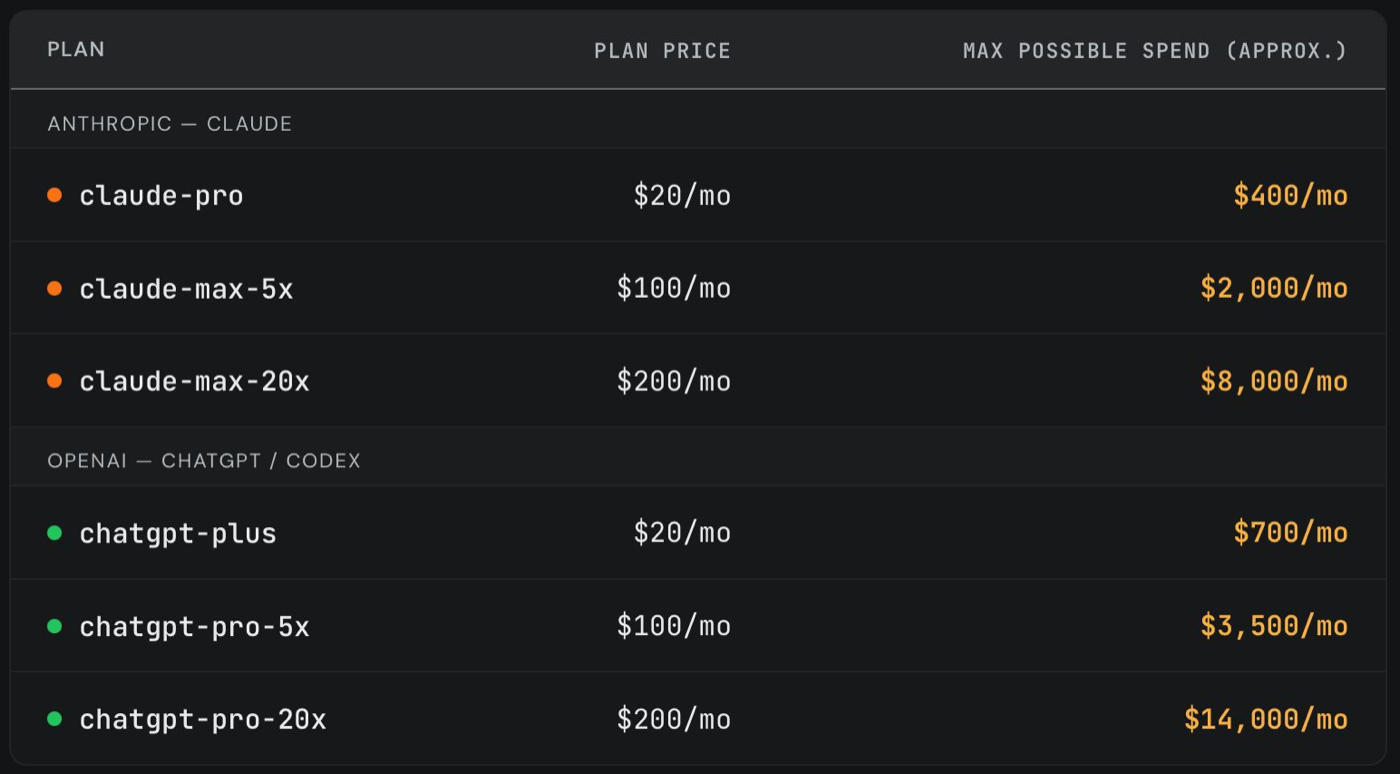 *图:SemiAnalysis 测算——一份每月 200 美元的订阅,在 Anthropic 可烧掉约 8000 美元 token,在 OpenAI 可烧掉约 14000 美元 token。*
没错。任何人只要有一份每月 200 美元的 Anthropic 订阅,就能烧掉 8000 美元的 token;有一份每月 200 美元的 ChatGPT 订阅,就能烧掉 *14000 美元的 token*。
*这门生意他妈臭得很!* 它根本算不上一门真正的生意!OpenAI 和 Anthropic 不得不白送出去相当于订阅费 20 到 70 倍的 API token,这意味着它们心知肚明:绝大多数人对这些 token 的估值,只有其真实成本的零头。 这种又龌龊又浪费的补贴,是你在对自家产品的实际价值毫无信心时才会干的事!
吹捧者俏皮话插一句: *可是 Ed,这是健身房模式啊!* 划重点,小傻瓜!如果你有 2000 个人每月付 20 美元、却几乎不产生什么成本,那也只需要*三个*人各花 14000 美元,就能把这笔营收一分不剩地吃光!而且相信我,毛利率的事我马上就讲到。
SemiAnalysis 还建模算了——基于一个荒谬的假设:OpenAI 和 Anthropic 在自家 token 上有 75% 的 gross margin(毛利率)——单个用户的毛利长什么样,我敢说那一定是个他——我的天哪!
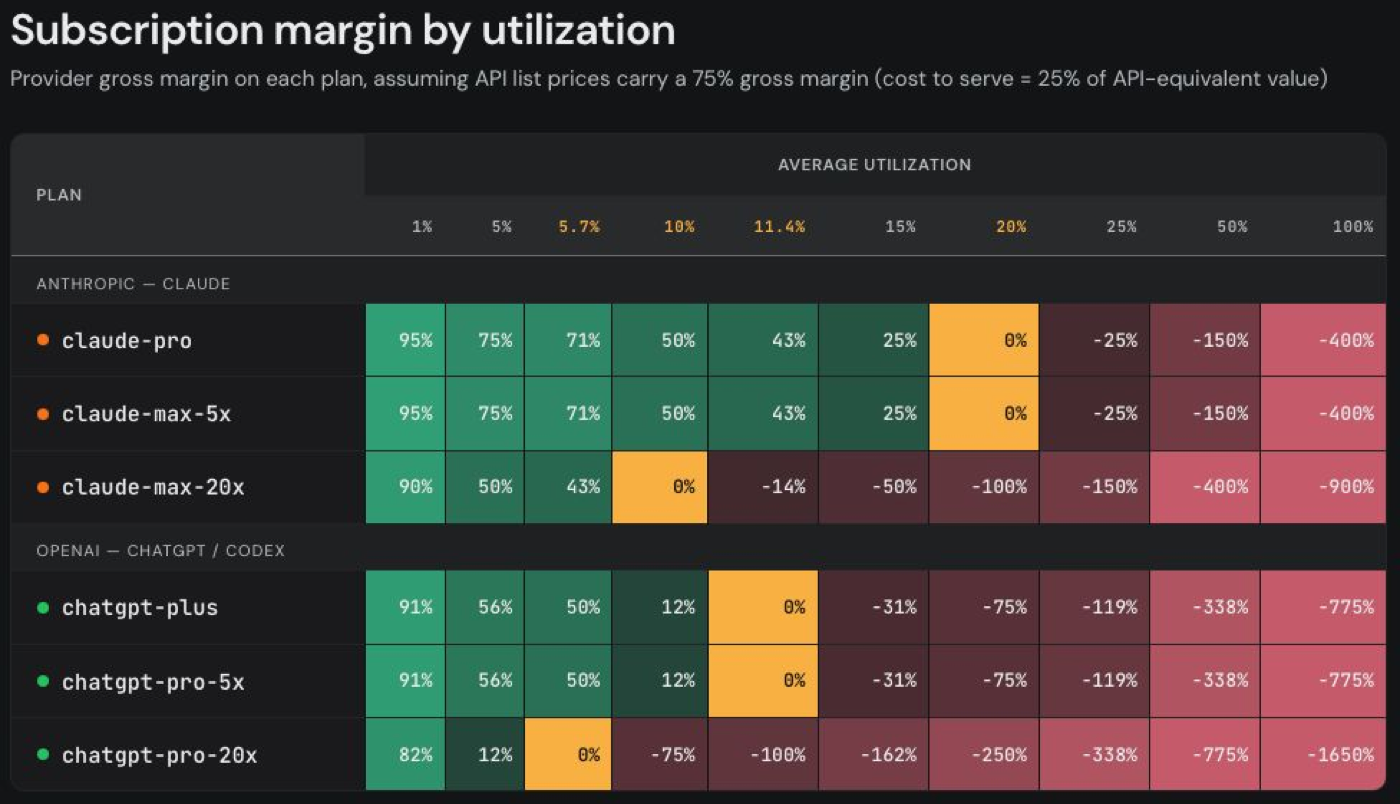 *图:SemiAnalysis 单用户毛利建模——即便假设 token 有 75% 毛利率,用户只要用掉区区 25% 的用量上限,毛利率就跌到至多负 25%。*
没错,各位。在当前的补贴下,一个用户的 gross margin(毛利率)要跌到*至多负 25%*,只需要他用掉*区区 25% 的 rate limit(用量上限)*就够了。而这还是建立在"它们的 token 有 75% 毛利率"这个慷慨假设之上的!
我再说一遍:这不是一门真正的生意!这是一门笑话生意、一门喜剧生意、一门由众神发明出来专门嘲弄风险投资的生意!Sam Altman 和 Dario Amodei 用这种方式经营一门生意,说明他们对自己的投资人、科技媒体、卖方分析师以及公众,统统满怀蔑视。要是你我把自己的日子过成这样,准会被骂成那种"觉得全世界都欠自己、财务上不负责任的千禧一代"。
这不是一个真正的商业模式,因为生成式 AI 公司根本不是真正的生意。
生成式 AI 没有商业模式。它不是一个价值能跟成本沾上一点边的工具。它对供应商和客户来说都没有变得更便宜。它也没有以任何"专为生成式 AI 发明的跑分"之外的方式变得"更好"——这是整个行业对一项平庸技术的集体宠溺,而这项技术只能靠巨额补贴、FOMO(错失恐惧)和高管的无知来赚钱。它需要无休止的预训练(pre-training)、后训练(post-training)以及各种脚本式的 MacGuffin(推动剧情的噱头道具)来完成任务,而这些任务带着数学上必然存在的幻觉(hallucinations),会烧掉更多 token,把成本进一步推给客户——而这些客户在被迫支付*一个本就不赚钱的成本*还不到一个季度时,就已经哗变了。
吹捧者和刚被敲了脑袋的人会说,这些公司只要停掉训练就行了——对此我的回答是:*要是这行得通,他们早就这么干了*;而且*一旦停掉训练,模型迟早会沦为无人问津的过气货*。要是只靠停训练就能让这些生意扭亏为盈,他们早就干了,因为那样推理就会变成一台印钞机,而不是一件啃噬着 Altman 和 Amodei 灵魂的诅咒之物。
AI 货物崇拜正在崩塌
我说过一次,现在再说一遍:我相信,绝大部分 AI token 花费——尤其是 Anthropic 的营收增长——都来自一群商业白痴(Business Idiots)。这群人跟任何真实工作都脱节,却被忽悠得深信"多用 AI"能干出点啥事来,而不是只会堆出一摞天价账单。
而你猜怎么着——*我说对了!*
在怂恿员工"tokenmaxx(拼命烧 token)"刚过去一个多月后,Meta 现在就计划收紧它的 AI token 花费了——因为它意识到自己照这架势要在 token 上花掉*数十亿美元*,据 The Information 报道:
Meta Platforms 计划通过给员工的 token 用量设上限,来遏制公司内部飞涨的 AI 成本——就在它推动员工在工作中采用 AI 工具仅仅几周之后,该公司在周二一份备忘录里向员工通报了这一决定。
据 The Information 看到的一份内部备忘录,Meta 正在搭建一个内部平台,用来实时追踪员工的 AI 使用与花费、设定预算、并为员工的 token 花费立规矩。Meta 本周早些时候把这份备忘录分享给了约 6000 名员工。这项举措是一个更大范围的、旨在削减成本的效率计划的一部分。
"我们看到 AI 使用量呈指数级增长,照目前趋势,光是内部使用,2026 年就要花掉数十亿美元,"备忘录写道。"与此同时,个人和团队对自己如何使用 AI 的可见度和掌控力都很有限。预计到 2027 年,Meta 将转向以更结构化的方式管理 AI token——配上预算、分配决策和配套工具。"
Meta 从怂恿员工比赛谁烧的 token 最多,到张口闭口像个英国议员在做紧缩政策演讲,前后甚至*没用上两个月*。
与此同时,《泰晤士报》报道称,多家银行正因"对人工智能工具的实验"而欠下天价账单,金额高达九到十位数:
RWS 首席执行官 Ben Faes 说,企业正越来越意识到所牵涉的成本,却对这些钱该怎么用没有一个清晰的结果。
"这非常令人兴奋,但你也知道,拿这些 AI 来回折腾的成本正在相当戏剧性地飙升,"他说。
54 岁的 Faes 说,他跟两家大银行聊过,这两家加起来已经为实验 AI 砸下了 10 亿美元的成本,却没产生什么像样的投资回报。
"这是个严肃的问题,"他说。"AI 可不是用来生成滑板上的猫咪图片的。它正在变成企业一个实打实的成本中心。"
这些话,正是你打算*大幅*削减成本时才会说的话。我觉得是 Uber 的 COO 给所有人松了绑,让大家敢承认:在 AI token 上砸下数百万美元,根本看不到 ROI,或者说,看不到*任何可衡量的好处*。
记住:商业白痴就是一群旅鼠!他们之所以想"搞 AI",唯一的原因就是他们在报纸上读到了,或者听某个他们以为很聪明的人信誓旦旦地说这就是未来。这群人对暗示(参见:Nik Suresh 的《今天就给一个高管洗脑》)和营销炒作极度敏感,这也意味着他们对同侪的评判同样极度敏感——意思是,一旦风向变了、所有人都开始说"我不确定我们该在 AI 上花这么多钱",他们就会*焦虑*起来,生怕自己因为干了几个月前还被视作*创新*的事,而被人评判为*铺张浪费*。
有人提议,对某些操作来说,价格更低的开源模型(包括一些中国研发的)也许是解药,据《华尔街日报》:
这个生态系统允许自主 AI 系统(即 agents)在许多功能上使用廉价模型——包括阿里巴巴、DeepSeek 等中国公司做的那些。这些 agent 只在处理更复杂的任务时,才去调用 OpenAI 的 ChatGPT 和 Anthropic 的 Claude 中能力最强的版本。据使用这些工具的高管说,这能把某些 AI 辅助工作的成本砍掉多达 95%。
"一旦我们发现某样东西好用、工程师也喜欢,我们就会想办法让它变得划算,"识别 bug 的初创公司 Detail 的创始人 Dan Robinson 说。"如今从那些开源实验室里冒出来的好东西,简直多得让人挑花了眼。"
Robinson 已经把 Detail 90% 的工作负载,从 Claude 和谷歌的 Gemini 转移到了自定义模型和 GLM 上——GLM 是一个在中国研发的模型家族。
这套论调的问题在于,我们还没证明运行这些模型对任何供应商来说是不是盈利的(甚至是不是可持续的),也没有切实证据表明它们能*在规模上*跟 Anthropic 或 OpenAI 那些更复杂的 LLM 竞争。
Citadel Securities(城堡证券)上周晚些时候论证说,它们或许能:
对整个经济而言,在物理约束被缓解之前,更简单的模型也许是更划算、更能增强生产力的路径。因此,我们看到前沿(frontier)AI 与"日常(everyday)"AI 使用之间正出现越来越多的分化(bifurcation)迹象。
问题是,那几千亿美元、塞满 NVIDIA GPU 的 AI 数据中心,是奔着*会有惊人需求*的预期建起来的——光是覆盖在建项目,每年就得超过 1500 亿美元——而且是奔着*超大、超吃算力的模型*去的。我仍然怀疑这是不是一场真正的转向,哪怕只是因为:用开源模型,要么你得跟一家推理(inference)供应商合作,要么你得自己跑 GPU。
尽管如此,光是这种迁移的*一丝苗头*,就足以让商业白痴开始念叨"嗯……要不试试开源?"——哪怕他们压根不知道开源是什么意思。
但一切都归结到一个非常简单的点上:大量 AI 使用(以及由此而来的 AI 花费),源于一种货物崇拜(cargo cult)心态——一个由史上最容易被牵着鼻子走的蠢货们掌舵的经济体。他们之所以跳上 AI 这趟车,是因为看了个网络研讨会,或读了条 LinkedIn 帖子,或看到一则新闻报道——比如Sam Altman 说他的技术很吓人,或《大西洋月刊》一篇文章说 Claude Code 是 ChatGPT 2.0——然后心想"操,我最好赶紧往这上面砸尽可能多的钱"。
说到底,这些机构到底在为*什么*买单?它们没替换掉任何人,也没有令人信服的证据表明 AI 模型能让人变快。让不懂技术的人用 LLM 写代码,并没有以任何可衡量的方式加快软件的交付,反而带来了显而易见的问题——你想啊,你手上有一堆由一个根本读不懂、也理解不了它的人写出来的代码。
人们会争辩说 AI"对做研究真的很有帮助",可事实是*你从 AI 那里得到的任何研究结果,**都绝对带着幻觉(hallucinations)*,意思就是:如果你并不真的知道某个问题的答案(而我猜,这正是你去研究它的原因),那你就一定会出某种小(或大)岔子。
在一个有点切中要害的故事里,《金融时报》上周报道称(援引GPTZero 的一项调查),毕马威(KPMG)一份讲 AI 好处的报告(现已被撤下)通过多处 AI 幻觉,夸大了 AI 的采用规模:
这份十月发布、题为《在 agentic AI 时代重新定义卓越》的报告,对包括瑞士银行 UBS(瑞银)、英国国民医疗服务体系(NHS)、以及瑞士联邦铁路和伦敦交通局这两家公共交通机构在内的多家组织的 AI 使用情况,做出了大量不实陈述。
这些失实之处被研究机构 GPTZero 认定为 AI 幻觉,并经 FT 核实。在被告知这一问题后,UBS 表示将要求 KPMG 删除这些虚假说法,而这家"四大"会计师事务所已于周四把该报告从它的部分网站上撤下。
KPMG 这份报告声称全球财富管理机构 UBS"在投资顾问、风险管理和合规监控领域全面集成了 AI agent"。UBS 一位发言人告诉 FT,这些断言"与事实不符"。
这份报告还包含了关于瑞士联邦铁路、伦敦交通局和 NHS 大曼彻斯特地区使用 AI agent 的幻觉,凭空捏造出了整套集成方案和产品线——而这份报告,很可能被拿去为数十亿美元的支出做正当性背书。
据 GPTZero,这份报告 45 处引用里有 40 处要么是假的,要么对内容犯了关键错误,要么细节不足以充当证据。他们还认为,写这份报告的人多半把活儿大部分都甩给了 AI:
我们团队怀疑,《Total Experience》(全面体验)的作者们用了某种 AI 驱动的文献引用工具来生成报告的引用,因为这些错误既是大语言模型(LLMs)典型的那类错误,又在整份参考文献列表中保持一致。一个人类不会前后一致地改写标题、把主题误当成作者(例如引用 9),或者在多个部分重复同样的信息(例如引用 2)。
GPTZero 还指出,这份报告正在被各种 LLM当作证明 AI agent 成功的证据来引用,进一步污染了这些模型本就充满幻觉的信息源头。
KPMG 年营收超过 390 亿美元,还在卖一个叫KPMG Workbench的东西,号称要"用(它的)多智能体 AI 平台为你的业务加速,把先进、可信赖的 AI agent 与 KPMG 专业人士的洞见和深厚行业专长结合起来"。我猜,给那份报告开绿灯的,就是同一批专业人士。
这事很可能是懒惰加无知的混合产物,但我也觉得,它可能是这么一种情况:写报告的那个(或那些)人,压根找不到任何真实引用来佐证自己的论点,于是干脆让一个 LLM 拉出一坨思维稀泥(thought-slop),指望没人会注意到。
在出过这种事之后,Anthropic 和 OpenAI 居然*还有*生意可做,这本身就证明了:绝大多数为这些服务付费的公司之所以付费,是因为它们感到来自同侪、投资人或媒体的压力。
这不是一个能撑得住的商业模式!靠 FOMO(错失恐惧)、靠煤气灯式操纵(gaslighting)、靠"只要你把信用卡交出来就会有好事发生"的含糊承诺,你也就只能走这么远。
操,咱们再往前推一步:OpenAI 和 Anthropic,没有一个是真正的生意。
OpenAI 和 Anthropic 不是真正的公司,它们只能靠白送来赚钱
咱们直奔主题:这俩根本不是真正的公司!
它们的生意只能靠补贴客户群、或者靠"让人们尽可能多用 AI"这种欺骗性的媒体宣传来诓骗客户才转得动;而越来越清楚的是,按 token 计费很可能真的撑不起一门可行的生意。
这些公司唯一的希望,曾经是它们或许真能收取一个接近真实成本的价格——不过我得说,这只在一种情况下成立:*OpenAI 或 Anthropic 将来还有把 token 价格往上抬的余地。*
更糟的是,有一件事昭然若揭:*绝大多数人永远不会真正为他们烧掉的 token 买单。* 如果 OpenAI 和 Anthropic 容许客户烧掉如此骇人的 token 量,那是因为它们已经看到:一旦不让客户这么烧,客户就会流失(churn)。Anthropic 在三月份那次激进的 rate limiting(限速)——即便那时候还允许人们烧掉远超订阅费的量!——多半把它们吓得屁滚尿流,吓到它们签约每月付给 Elon Musk 12.5 亿美元,以换取使用他的 Colossus 数据中心的权限,*目的就是为了能给用户更高的用量上限*。
这些公司唯一能赚钱的方式,就是白送。OpenAI和Anthropic最近都开始派发 1000 美元的 API 额度,来劝人们转用 Codex 或 Claude Code。
题外话: 现在OpenAI 允许用户"存起来(bank)"自己的 rate limit——意思是你不必等每周(或每小时)的额度重置,可以选择把额度攒起来,然后(我猜)连着背靠背使用,让重度用户在跑完自己的用量后,能有效地对 OpenAI 的服务器"二连击"。
此外,在接下来两周里,凡是被人推荐来的用户都能免费试用 Codex,*而推荐人和被推荐人都能再多得一次可存起来的额度重置。* 这是一种明摆着的、以数百(甚至数千)美元为代价来给用户数注水的把戏,而且几乎只会被那些钻系统空子的重度用户利用。
它们的服务不够值钱,撑不起人们去覆盖它们的运营开支——就算你把训练成本剔掉也一样,而训练成本之惨重,单它一项就足以淹没每一美元的营收。它们没法涨价——甚至连把价格调到跟成本持平都做不到——否则用户就会炸毛。它们的训练成本是为了让模型继续"好"到某个说不清的程度所必需的,这意味着这些成本是*销货成本(cost of goods sold,COGS)*,而*不是*资本支出(capital expenditure,capex)。
顺带说一句: 有人告诉我,Anthropic 一直在跟别人说,可以把 token 花费当成一笔资本支出(capex)。我警告全世界任何一家公司:要是让我发现你这么干了,我会缠着你一辈子。我会永远盯着你做的每一件事,因为这是一种近乎欺诈的狗屁会计手法,而我能想象,肯定会有某个混蛋去这么干。
Anthropic 和 OpenAI 想让你相信它们的生意终有一天能扭亏为盈,可它们俩谁都拿不出半点关于"怎么扭亏"的说法。Anthropic 谈下了它那笔 SpaceX 交易前两个月的折扣算力,好假装自己在单个季度里是盈利的,但任何一次降价——甚至只是客户流失!——都会立刻把它的财务打入那种通常只属于"窘迫到家者"或"嗑了类固醇者"的赤字。
它们没有计划。
你尽管去念叨 TPU、Trainium、Inferentia 和各种自研芯片,念多久都行——运营这些公司就是不赚钱,它们的成本太高,它们的客户对价格敏感。它们的客户为自己实打实的 token 消耗付费,撑了*不到三个月*就开始喊救命了。这个趋势没法逆转,因为如果能逆转,OpenAI 和 Anthropic 早就用尽一切办法逆转它了,而不是去融比任何人都多的钱——表面看不出有什么别的理由,纯粹就是为了把钱烧掉。
OpenAI 和 Anthropic 是两家不可持续、经营鲁莽的公司,出了硅谷那个崩坏的世界,它们就讲不通。科技行业和风险投资被一帮创造不出任何价值的过气大佬把持着,以及对 2015 年之前那个时代的模糊记忆——在那之后,投资人放弃了投种子期公司,转而年复一年地、毫无乐趣地追逐潮流,直到被新冠封锁和"X:万能应用(The Everything App)"逼疯。
科技行业被这样一群人把持着:他们既不经历真实的难题,也*用不着*经营真实的生意,因为总有一帮同道骗子会把他们重新捧回盈利区。投资如今不再基于硬核的精英主义、或者对开创未来的任何兴趣——它只关乎腐烂经济(Rot Economy)那套平庸的"不惜一切代价求增长"的加速主义,关乎让形形色色的数字往上走,尽管极少是跟利润沾边的那些数字。
我觉得,到了这一步,问一句也算公道:考虑到 AI 那高得离谱的成本,你是不是本可以直接雇真人来干 AI 干过的那些破事?14000 美元,大概能让你从一个真正的软件工程师那里得到一笔很划算的交易——见鬼,你大概还能雇一家代理机构替你把活儿干了,而且真有个人来替你管控风险。
关于 AI 行业那个纯属臆想的假设是:它会神奇地变便宜。这种事并没有发生。更多的数据中心不会让 OpenAI 或 Anthropic 盈利。更多的数据中心不会让客户更愿意为 AI 的真实成本买单。更多的风险投资也不会让 Anthropic 或 OpenAI 变成真正的生意。
我赞同任何主张"应该暂停生成式 AI 开发"的人,但我的理由是:我相信这是一场注定失败的骗局,是一场伪装成行业的科学实验——它之所以能撑这么久,唯一的原因就是它让硬件行业得以从初创公司、风投、资产管理公司,以及养老金和保险基金身上榨走数千亿美元。
而硅谷里任何一个自欺欺人、以为自己不只是个企业走狗的人,都是个待宰的傻瓜。
硅谷是一片单一栽培
AI 行业,与让硅谷扬名立万的那些东西,正好相反。
它把一切都碾平,吸走了大部分风险投资、媒体注意力、人才和智识氧气,不管你身处哪个领域它都要侵入进来——因为投资人坚持你必须跟 AI 沾上点关系,因为所有人都被说服了"我必须得用它"。它是一个智识黑洞,把每一场对话都往自己身上拽,索要最多的钱、最多的关注、*没完没了*的辩护和正当性论证——而那些胆敢质疑"LLM 是不是未来"的人则必须被驳斥。它通过逼迫粉丝们不断直面各种难堪与丢人现眼,来贬低和羞辱他们,比如它删光了整个数据库,或是把 AWS 搞崩了。它让使用者的智力退化,并且,由于它要求你完全的虔诚才配被算作"硅谷的一员",它窒息了那种据说当初让这帮混蛋发了大财的、精英主义式的怀疑精神。
硅谷立身的根基,是一个或许根本就是虚构的理念:一群无畏的软件开发者,拒绝企业主义(corporatism)的束缚。如今它却把美国企业界最糟糕的那些品质统统吞了进去——群体思维、追逐潮流、部落主义、英雄崇拜、管理层的封建做派,以及为了博一个被宠坏的有钱蠢货一笑而追逐各种东西的铺张浪费。硅谷身上没有任何无畏或个性可言。到了这个地步,你他妈还不如去麦肯锡上班算了。
硅谷*就是*那个建制派(the establishment)本身。OpenAI 和 Anthropic 实际上归微软、谷歌和亚马逊所有——它们在基础设施和财务上不是"有依赖",而是它们主要就跑在这些巨头的硬件上;一旦它们出点什么事,多半会被七巨头(the Magnificent Seven)旗下的多个部门吸收掉。
它们在财务上的成功,只让硅谷最有钱的那群人、以及股市上最富的那些公司获益。它们标榜自己在让软件民主化,与此同时却从风险投资那里榨走尽可能多的美元,还反过来卖给投资人一个关于传播"丰裕(abundance)"的故事。
AI 所代表的,是把初创公司商品化,当作那些市值上万亿美元的科技巨头的燃料。AI 初创公司存在的唯一意义就是把钱往上输送,烧着 Claude 或 GPT 的 token,而这些 token 跑在那些巨头建造并拥有的基础设施上——正是这些巨头,恰恰是硅谷自诩为荣、号称要掀翻的对象。
硅谷的群体思维和单一栽培(monoculture),用煤气灯操纵把这群可怜虫忽悠得深信会有某种皆大欢喜的结局,而不是缓慢滑向资不抵债;又骗着他们去为昂贵、不可持续的工具辩护,用的是一套只让地球上最有钱的那群人获益的神话。
最近有人说,他认为 Anthropic 和 OpenAI 是"最后的初创公司",说再去建别的什么都没意义了,因为"一切都已经被解决了,或者很快就会被解决"。
我同意——尽管理由完全不同。
Anthropic 和 OpenAI,代表了我认为可能是最后的超高速增长(hypergrowth)初创公司,而它们的崩塌(无论以何种方式发生)将标志着一个梦想的终结——那个"创办一家小公司、把它变成下一个谷歌或 Meta"的梦想。
没有微软、谷歌或亚马逊的介入,这两家公司谁都不可能存在——是这些巨头提供了它们最早的资金,以及最关键的,它们的全部物理基础设施。Anthropic 和 OpenAI 从一开始就完全依赖这些超大规模云厂商来扛起那 1000 亿美元以上的基础设施成本,才让训练它们最早的模型、或提供推理服务成为可能。
之所以再没有别的与 Anthropic 或 OpenAI 同等规模的初创公司,是因为它们俩压根就不是初创公司。它们不是什么靠肩膀硬撞、一路撞到近万亿美元估值的无畏黑马——它们简直就是字面意义上的、全球最大那几家公司的子公司,只是借用了初创生态的神话,来制造一种错觉:仿佛*任何人*都真能跟科技巨头竞争。AI 初创公司全都完全依赖科技巨头,却把自己包装成无畏的个人英雄。
亚马逊故意把 Anthropic 举报给商务部,而微软和谷歌都没表现出半点替它出头的兴趣——这一切表明,这两家谁都不在乎 Anthropic 是死是活。这本该恰恰是那种能证明 Anthropic(或 OpenAI)对它们的超大规模金主拥有真正筹码的局面。结果呢,全球最大的几家公司把它们丢给了狼群。
Anthropic 一直以为自己大到不能倒,或者至少大到没人能拦得住。它多半以为自己会像跟国防部那场争执时一样,看到铺天盖地的支持涌来,但似乎没人对替它出头特别感兴趣。相反,所有人看起来都有点困惑又恼火,而全球最大的那几家公司,正在含糊其辞地说什么"没有哪个单一模型能是'最好的'"。
硅谷啊,这就是你们的国王——一家靠着大规模地诓骗、恐吓和欺瞒众人而成长起来的公司,把自家模型的能力和可能性都夸大其词,指望所有人都吓得*不敢不*为它付费,结果却眼睁睁看着自己的商业模式崩塌——因为你他妈没法靠许愿就许出一个商业模式来。
虽说 OpenAI 也好不到哪儿去,但 Anthropic 之所以特别招人厌,在于它活脱脱就是那些毁掉科技行业的东西的集大成者——一家产品成本高达数十亿美元、却只能靠大谈"它将来或许能干什么"来兜售的公司,一件骗术与狂妄的杰作,而我相信,它将来会跌跌撞撞、轰然崩塌。
下一代初创公司,不会在一个对 Twitter 上的虚名和追逐潮流的兴趣、远胜过对"做出能解决真实问题的好软件"的兴趣的系统里诞生。脑子坏掉的、增长上头的"加速主义者",把经济增长跟人类进步混为一谈;只要他们还大权在握,唯一能做出点像样东西的,就只剩那些真正的局外人。
如今你已经没法以一家初创公司的身份赢了。没有七巨头你就没法竞争、没法扩张——至少在硅谷当前这套规则下不行。
而且,除非狠狠地、彻底地把当下这一代风险投资人的狂妄与无知冲刷干净——他们已经放弃了开创未来,转而跪在管理咨询师和骗子脚下祈祷——否则这种局面将永远无法再被打破。